


My 2026 predictions sketched out the overflow of the AI hype cauldron and its aftermath. But how did we get here? What created these circumstances, and how are they connected?
In my final post of 2025, I present the 5 key numbers that summarise its biggest stories. Whilst not really strictly scientific, they illustrate our mixed feelings for this year: exuberance, uncertainty, and a sense of impatience about what lies ahead.
5 trillion dollars
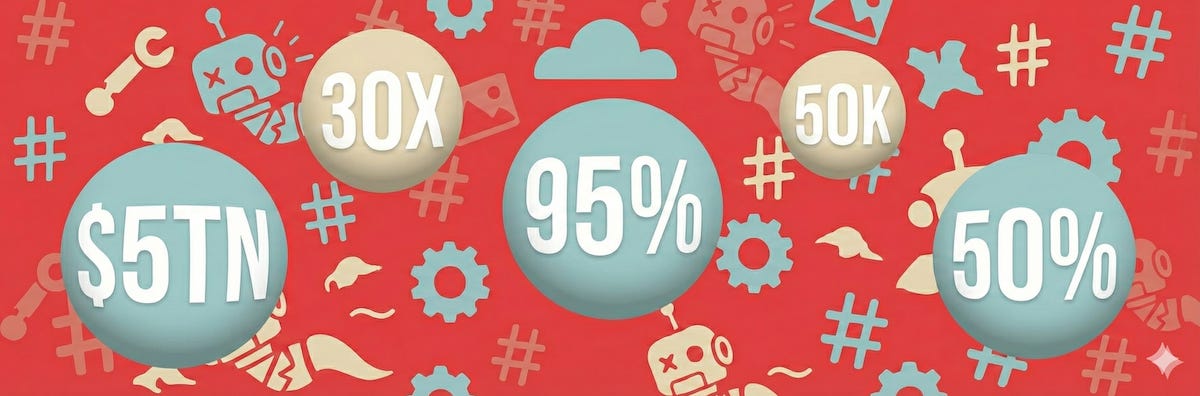
The T-Rex of the big scary AI numbers, $5TN, is both the peak valuation of Nvidia, and the CapEx that Big Tech has earmarked for AI data centres until 2030, according to McKinsey. Depending on who you ask, there are 5 trillion reasons we are in a remarkable boom or a precarious bubble.
30X cheaper
The release of DeepSeek R1 in January made a big splash and even a bigger dent in Ndivia’s stock, thanks to a new approach and clever engineering. To understand why the frequently cited 30X cheaper is a game-changer, consider that it represents a 97% cost reduction relative to the competition.
95% pilots failed
Perhaps the most-cited figures of the year: 95% of all AI pilots have failed to deliver ROI, according to MIT. Though the methodology is dodgy, the noise it generated spoke volumes. Commentators jumped on it because it supported our collective observation that business adoption remains underwhelming.
55K jobs lost to AI
Although evidence of AI’s impact on jobs across economies is limited, the announcements are sufficient for CNBC to estimate that AI eliminated 55,000 jobs, mostly in tech. With vibe-coding valuations reaching for the stars, it seems that software developers are on their way to making themselves redundant.
50% of web content is AI
Slop, rage-bait, parasocial - the words of the year indicate our impatience that AI is making everything, everywhere, all at once. Whilst the figure that half of all internet content is AI-generated is speculative, there is no question that we are overindulging. Keep it up, and the word of 2027 could well be “model collapse”.