


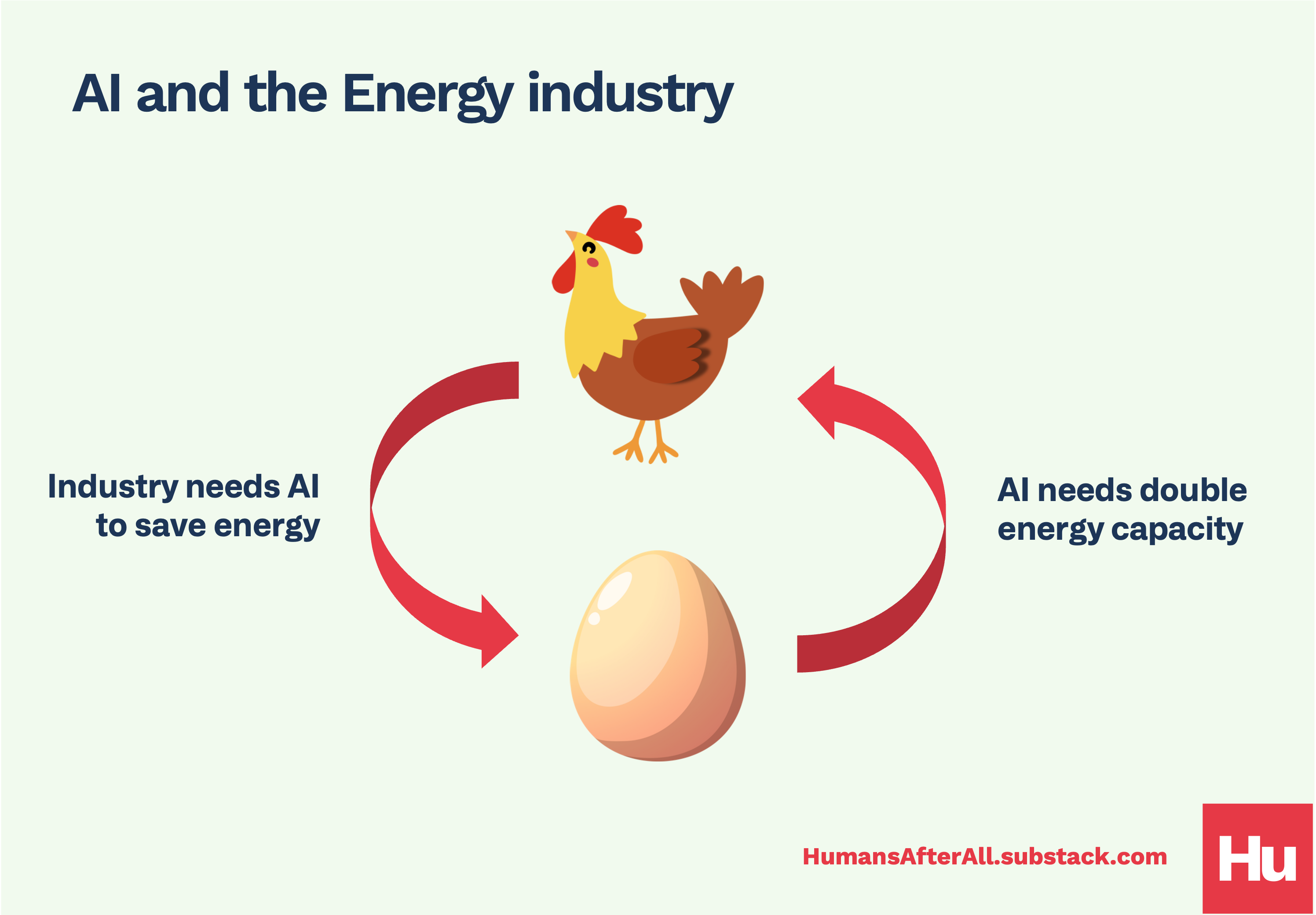
According to the International Energy Agency's latest report on the nexus of Energy and AI, "the transformative potential of AI depends on energy". Even in the "high efficiency" scenario, data centres will need more than double the electricity supply by 2023.
The transition is already underway. Investment in AI infrastructure (data centres, energy systems, and semiconductors) is making a dent in economic data. The energy industry now faces a dual challenge: powering the AI revolution while managing its impact on climate change. To succeed, companies need the precise optimisations and marginal efficiency gains that only AI can deliver.
Hence, the planetary chicken-and-egg question: can the energy industry use AI to save enough energy to power AI?
Can AI fix AI?
Encouraging case studies are beginning to emerge. One of my favourite examples is how Brainbox AI helped Dollar Tree save 8 million kWh of electricity annually, roughly equivalent to the energy consumption of a mid-sized data centre. Since the AI uses only a fraction of the data centre's capacity, the savings offset its costs, as well as those of all its neighbours.
The use cases are there, but significant scaling up is needed. To cover the 500 TWh of extra electricity that AI will require in 2035, we would need 62,500 initiatives of a similar scale worldwide. This is an ambitious yet feasible goal, provided the energy sector adopts AI quickly and implements large-scale energy efficiency measures.
AI excels at uncovering gains in the margins. To take another example from Perceptual Robotics, AI may not invent a new wind turbine; however, by predicting the maintenance needs of turbines, it reduces their downtime and increases their efficiency. Improve enough turbines, and the savings will compensate for the AI solution, and thousands more.
Where we spend our energy
I am painting a relatively optimistic picture, where AI is not only energy-neutral itself, but also generates sufficient savings for other worthy applications. On the downside, we face the very real prospect that slop production will drown out any savings that we can achieve. Worse, if these savings fail to materialise, the impending struggle to secure energy for geopolitically crucial AI could get nasty.
Nevertheless, I remain an optimist. From Prometheus onwards, humans have become adept at investing energy to generate more energy. We can do it again.