


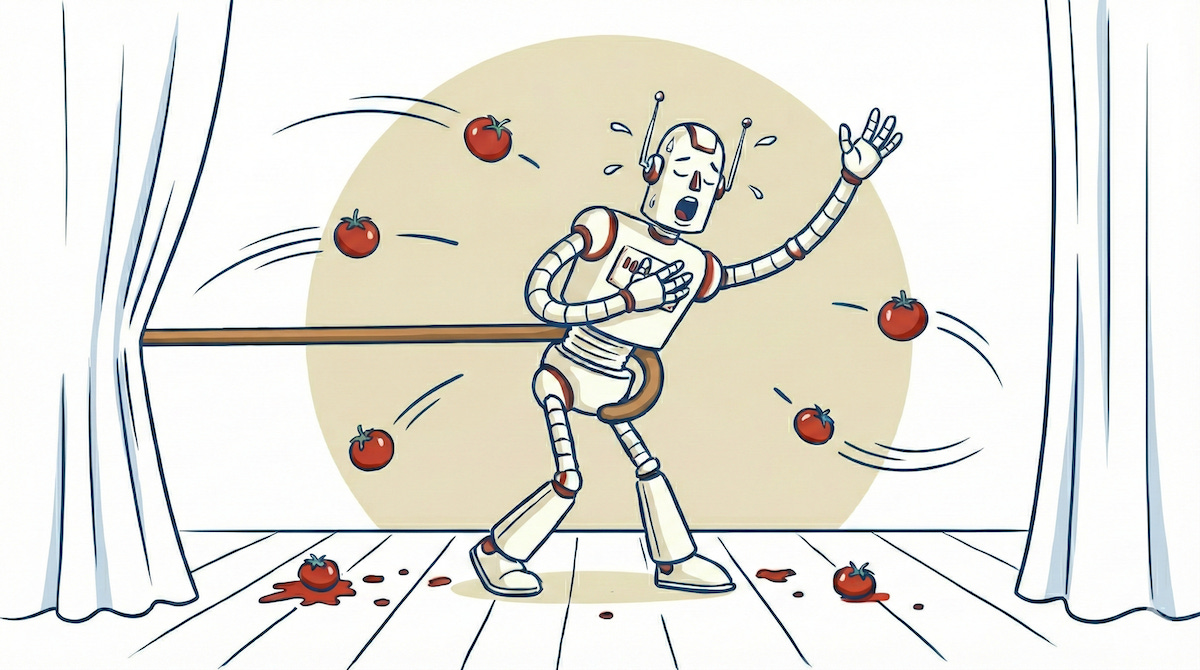
The evidence is mounting. “Can I finally get through to a real person?” asks the frustrated user. “Look at this—it just totally made it up!” exclaims another. Even early adopters report that AI features are becoming overexposed, hogging the limelight and obscuring utility.
Just as brands do not plaster “Hosted by Azure” or “Made with Tailwind” across their homepages, it is time for AI to recede into the background. While AI can power a responsive, personalised experience, customers do not want it to be the experience.
Resistance is building
Over the last few months, resistance to AI has been observed across multiple feedback channels. User testing, analytics and surveys reveal a negative reaction to explicit “AI features,” ranging from mild irritation to active hostility.
This stems from three perceptions:
AI is a cost-cutting hack that blocks human access, over-automates customer service, and handles edge cases poorly. At some point, every customer will face an unusual situation, so the effect is felt across the board.
AI produces poor results, confirming expectations of inaccuracies and hallucinations. Brands are held to a higher standard than free tools, and hard-won reputations unravel quickly.
AI is not to be trusted, driving fears of harmful hallucinations and mass unemployment. With media coverage oscillating between the apocalyptic and messianic, mistrust is bleeding into user sentiment.
99 problems, AI is not one
Customers have multiple reasons to interact with digital platforms, none of which is AI. They want to access information, purchase a product or manage their account. AI can make these interactions more pleasant and personalised, but it should not overshadow the experience.
Consider the following friction points:
Customers are tiring of typing. Chatbots and search boxes are taking up increasing amounts of screen real estate, yet users still prefer point-and-click and touchscreen interactions.
Customers are becoming “slop aware.” Generated text and media are increasingly viewed as low-value fillers. While AI is an invaluable creative assistant, it should be part of the process, rarely the final product.
Customers appreciate exit routes, such as a direct line to human agents or the option to hide AI content. Anecdotally, Google’s AI Overviews are widely adopted because they can be overridden via the Web tab.
AI-native means AI-inside
It is not a paradox that customers are enthusiastic about AI yet sceptical of how businesses employ it. Chat conversations are ephemeral; brand relationships are more permanent and demand higher quality.
Chat conversations are ephemeral; brand relationships are more permanent and demand higher quality.

Many businesses, keen to demonstrate an innovative edge, are becoming performative with AI. This risks creating a disconnect with customers who care about the utility and the experience, not about the technology behind it. Worse, AI overexposure can backfire, leading to a loss of trust and reputation.
AI will likely remain the main act in investor pitch decks for some time. But when it comes to products, it is time for AI to join the rest of the tech backstage.