


Anthropic CEO Dario Amodei recently invited us to imagine AI as a “country of geniuses”. While intended as a metaphor for rapid progress, the imagery is unsettling and out of step with economic and cultural reality.
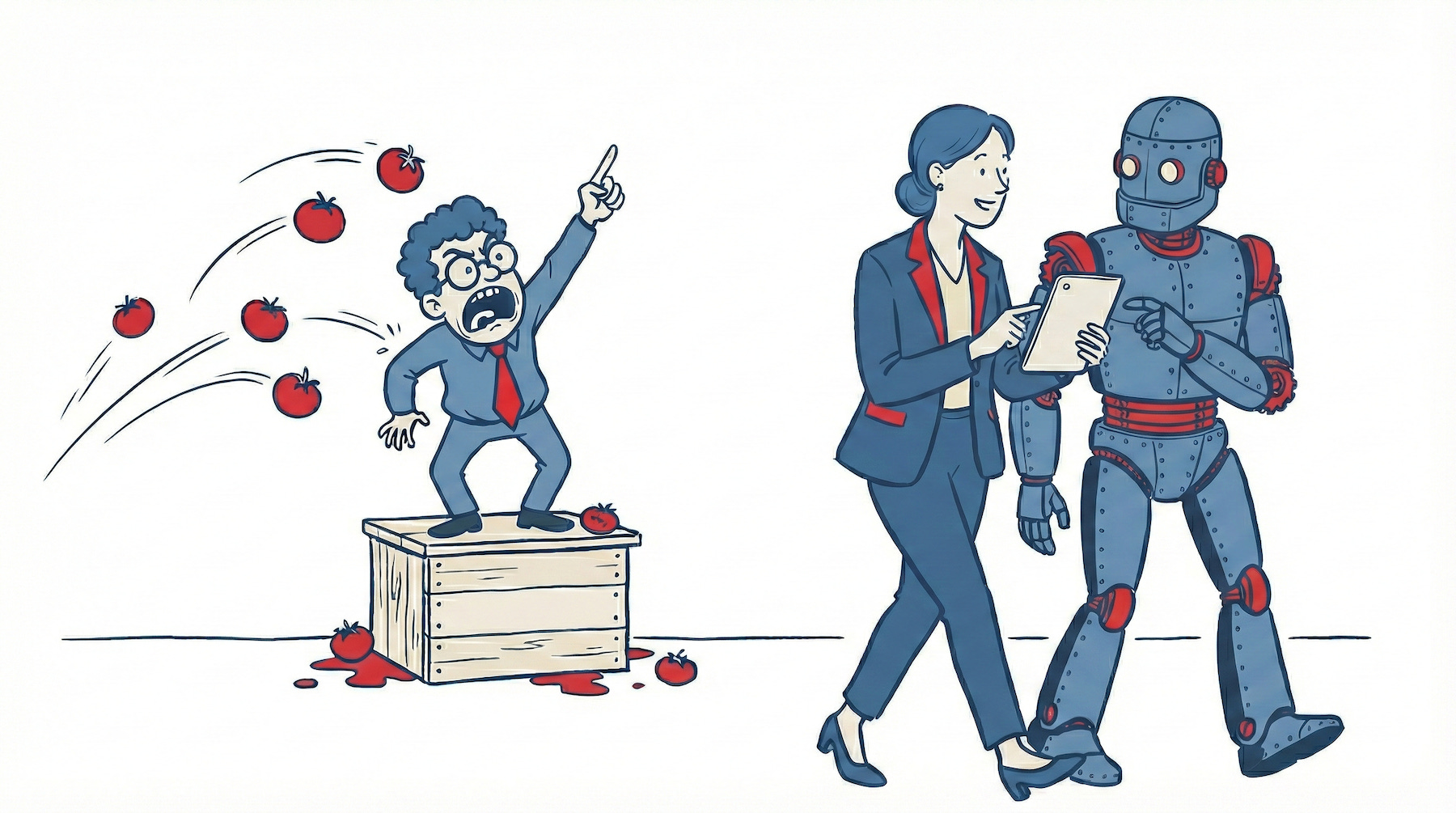
This disconnect between messianic rhetoric and output is fuelling a “botlash” that is moving fast from protest to obstruction. As resistance mounts, leaders must face the delicate balancing act of adopting a technology whose creators are increasingly unpopular.
How can businesses deploy AI while keeping a distance from the creepy AI industry?
I. Where are the gains?
The economic windfall from AI is late. Although most economies grew in 2025, hiring has generally slowed. Growth generated by investment rather than efficiency is unevenly distributed. In the US alone, 90% of growth is attributed to spending on data centres.
At the same time, adoption remains broad but shallow. While 41% of US workers used generative AI by late 2025, only 13% use it daily. Globally, whilst 14% of the world's population uses AI, a tiny 0.3% pays for it.
One explanation is that the noise is causing “organisational rewiring” to stall. Leaders are reluctant to redesign workflows and fully leverage AI’s capabilities until the dust settles.
II. A “botlash” is brewing
In the meantime, a “botlash” is brewing, as resentment converges across the political spectrum. Campaigns like “QuitGPT” and “Resist and Unsubscribe” now frame non-usage as a form of modern-day strike. Opposition is also moving to the physical world, as communities halted the construction of 20 data centres in just three months last year due to resource concerns.
Legislators are responding to this pressure. In the US, state legislators introduced over 1,200 AI-related bills in 2025 alone. The EU is opening multiple investigation fronts to curb the sector's excesses.
III. Diverging attitudes
Attitudes are diverging sharply by geography and age. Recent data highlights a fracturing consensus, with scepticism rising in developed economies and among younger cohorts. Nervousness is particularly acute in markets where white-collar stability feels threatened.
Simultaneously, whilst Gen Z most frequently uses generative AI, it is also the most anxious about its implications. This creates a workforce that is simultaneously dependent on the tools and resentful of the displacement they represent.
IV: A fine balancing act
For European business leaders, the path forward requires putting the technology to use, while insulating their brand from the backlash against its creators. This involves a number of subtle changes:
Know the supply chain. IT neutrality is untenable; leaders must keep an eye on the tech they use and the values it represents.
Augment, don’t replace. The backlash is fuelled by fear of job displacement, so adoption strategies must focus on augmenting teams.
Human-centric signalling. As tech giants alienate customers, there is SMEs can differentiate themselves by being aggressively human-centric.
Amodei’s “country of geniuses” paints a dystopian vision in which synthetic intellects rule and humans exist only on the margins. The public loves the tool but is beginning to hate the industry and its mesianic posturing.
Business leaders must walk this fine line, exploiting the opportunities of AI whilst keeping a distance from its creepy, tone-deaf creators.
Further reading
Dario Amodei, The Adolescence of Technology
The Economist, The AI productivity boom is not here (yet)
Financial Times, The ‘botlash’ movement is gaining momentum
Pew Research Center, How people around the world view AI
Harvard Business Review, How Gen Z uses Gen AI – and why it worries them