


“Can you all see my screen?” asks the founder, nervously. A couple of people give a thumbs up, and off she goes with her pitch. The problem is urgent, and yet no one has approached it this way — yet. The solution is scalable, the market is substantial (and growing), and the path to hockey-stick growth is credible.
Listening to startups pitch their vision is great fun. As angel investors, we love the energy, the passion, the creativity. But we also know that the weakest slide in the deck will be the one about competition.
“So what’s stopping a larger company from copying you?” is usually the first question to come up.
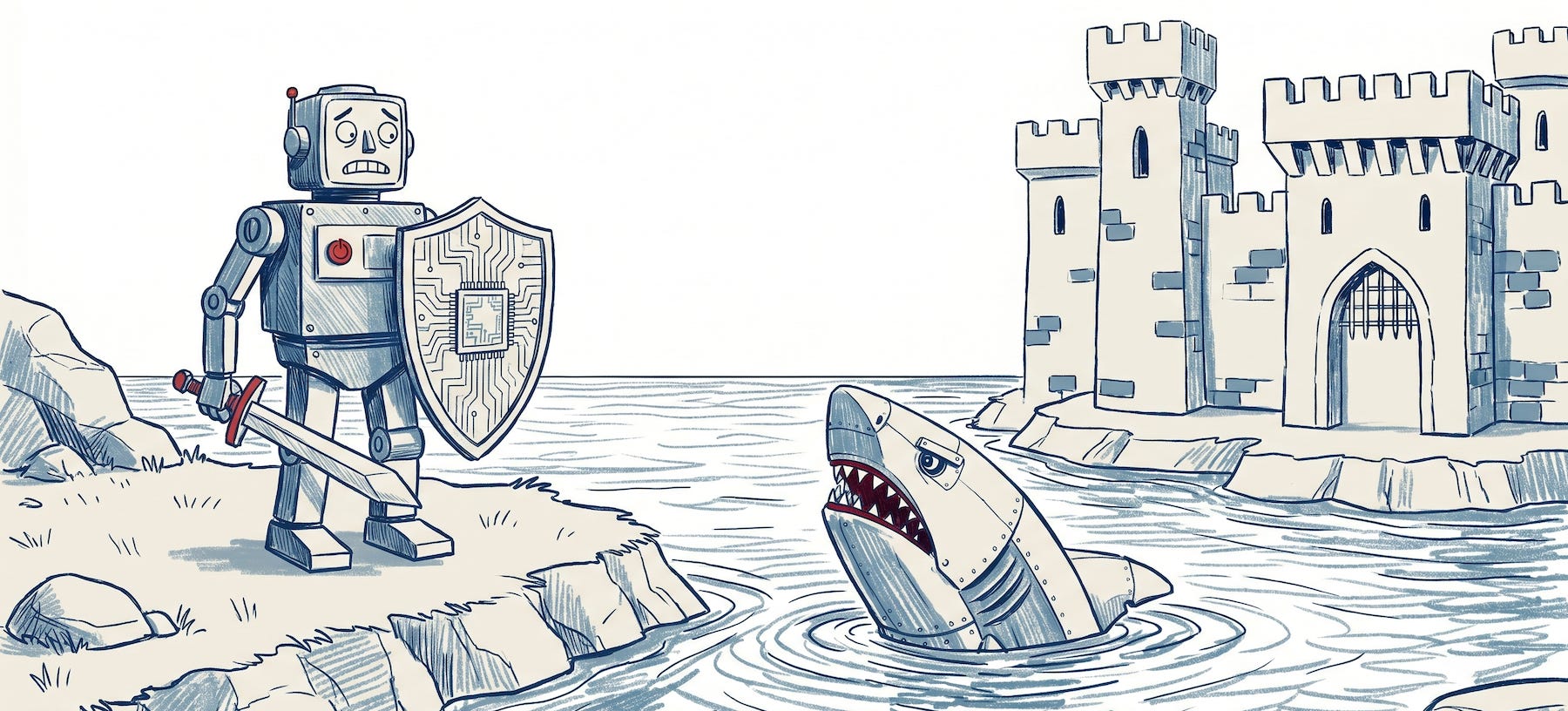
Very few founders can explain convincingly why a well-resourced competitor couldn’t replicate their idea. They design a castle in exhaustive detail, but pay little attention to the moat that determines whether that castle survives or not.
Scale-ups and established SMEs face a similar challenge. The walls may be higher — brand, customer relationships, operational depth — but the same barbarians are battering at the gates, and they have very deep pockets.
☞ AI is the infrastructure of innovation
Using AI is no innovation, but no innovation is possible without it. At the same time, in a frantic quest to generate revenues, AI Labs will soon be entering your sector. Sustainable advantage lies in using AI to build what AI cannot replicate.
Barbarians at the gate
There is a pattern in how Anthropic, OpenAI and Google expand their footprint. A capability first emerges in research, then becomes a product feature and finally a direct market entry that can render whole categories of software redundant.
Claude is the most visible example. Anthropic’s coding agent didn’t just add code generation as a feature. It entered the software development process directly, threatening dozens of startups that built their castles around these workflows.
The same dynamic is now playing out in design, where AI-native tools are absorbing layout, asset creation, and UX work that once required both specialist skills and specialist software. In financial services and healthcare, the Labs are moving into analysis, reporting, and compliance, charging into territories hitherto occupied by specialist firms.
Which sector is next? Legal is already partially breached. HR and talent management are under sustained pressure. Sector-specific tools are particularly exposed, as the “specialist” moat works only so long as an LLM can’t do the same job adequately. As capabilities improve, one sector after another comes under attack.
What floats your moat?
When I sit with a founding team or step into an innovation meeting, I run a short diagnostic based on three questions. Honestly answered, the answers reveal more about the company’s defensibility than any competitive matrix.
Q1. If Anthropic enters your space, what’s left?
If a Lab ships native capabilities that cover your core use case, what remains of your value proposition? Agility and user experience are not defensible. A genuine moat is something a model cannot replicate: proprietary data and outputs, regulatory accreditations, supply chains and locked-in relationships.

A genuine moat is what an LLM cannot replicate
Q2. What will slow down a well-funded competitor?
Assume a well-funded competitor starts building today. How long before they reach your position, and what specifically slows them down? “We have a head start” is not an answer. “A regulatory certification that takes 24 months to acquire” is a moat. So is “data from a sensor network we have been collecting for four years.”
Q3. If you get 10X more customers, do margins improve?
A business is defensible if its core asset grows more valuable with scale. To achieve this, each new customer must cost less than the last. Many AI-natives fail this test because their costs are tied to compute use. A true moat requires a virtuous cycle in which growth begets profits, reinvested in growth.
The best offence is defence
Ironically, some of the most durable competitive advantages in the AI era are non-digital. Brand equity, customer loyalty embedded in long relationships (and contracts), physical infrastructure, supply chains, regulatory licences and accumulated organisational knowledge cannot be prompted into existence.
For startups, this means shifting the focus to building barriers. Spend less time on the product and more on operations: clearing cross-border regulatory hurdles, collecting data and locking in customers and suppliers. Moats are made of boring stuff.
Spend less time on the product and more on operations. Moats are made of boring stuff
For established companies, these defences must be protected and reinforced. The question is not whether to adopt AI, but how. Automating mundane tasks is a start, but deepening existing advantages is where you will find true value.
Takeaways for leaders
Like electricity or the internet, AI can neither differentiate nor defend. AI amplifies what already exists: it will not conjure a moat where none exists. The winners will be those who use AI to entrench existing advantages.
Three things worth keeping in mind:
1. AI is innovation infrastructure
The competitive advantage is in the data, workflows and relationships. AI matters only if it can strengthen those foundations.
2. Invest in the basics
Brand equity, customer loyalty, regulatory clearances, and physical assets are hard to replicate, and they are consistently underweighted.
3. Put yourself through the tests
Can Anthropic overrun you? What will delay competition? Does profitability grow with scale? Explore these questions with people who are empowered to speak their minds.
Using Claude to fend off Anthropic
AI is unusual in that it is both a threat and a defence mechanism. Every time I walk into a pitch or an innovation session, I find myself asking the same thing: Can we use Claude to defend against Anthropic?
AI is fully “democratised”: available to everyone, it differentiates no one. Nonetheless, as a necessary tool for innovation, the market expects you to use it widely and confidently. The question is: What can you build with it that others cannot?
Further Reading
Aggregation Theory (Stratechery) — the foundational framework for understanding how value is captured and defended in digital markets.
Leading AI labs have no ‘moat’ except access to capital (Fortune) — a compelling argument that frontier models are becoming commodities.
AI Won’t Give You a New Sustainable Advantage (HBR) — AI only compounds advantages you already have; it cannot conjure them from scratch.
From AI Table Stakes to AI Advantage (McKinsey) — a practical framework on proprietary data, embedded workflows, and customer trust.
What is MCP? A Business Leader's Guide (Epinium) — A non-technical explanation of the Model Context Protocol and why it matters.