

Twice this week, I sat through the same lament. Different companies, different managers, identical puzzlement: we bought the AI tools, we paid for the licences, we ran the training. Then — silence.
My ears pricked up because I knew the second half of the story. The very people ignoring the corporate AI are drafting emails, summarising contracts and debugging code with AI all day long. But they all seem to prefer using their own accounts rather than the shiny new company toolkit.
Team members use AI enthusiastically, so long as it is not the one their employer wants them to use. Why is that, and what can business leaders do to address it?
The key idea
The AI adoption gap between employees is closing, but remains persistent. It coexists with heavy personal use, making it more about shadow adoption than reluctance. Its roots are psychological and organisational, so the remedy lies in better management and tool design.
A level playing field
The AI adoption gap is striking. IBM’s 2026 CEO study found that 85% of employees have access to AI at work, but only 25% use it regularly. That gap is remarkably steady across financial services, manufacturing, healthcare and retail. BCG’s AI at Work survey christened it the "silicon ceiling": three-quarters of leaders were using generative AI several times a week, while frontline use stood at 51%.
Beneath these numbers runs a lively shadow economy. Workplace usage data show that employees at over 92% of Fortune 500 companies actively use ChatGPT, but that nearly three-quarters of those accounts are personal rather than enterprise.
The good news is that the problem looks fixable. BCG’s 2026 follow-up recorded frontline regular use leaping from 51% to 74% in a single year, credited chiefly to “leadership support”. Easier said than done. To uncover concrete actions, leaders must understand the reasons why teams snub corporate AI.
Stealth mode
Start with the interface. A chat feels a lot like a private conversation, and that quasi-intimate setting is what makes it so compelling. In that safe space, a half-baked question costs nothing, a first draft is allowed to be dreadful, and no one listens in to your internal dialogue. Route a chat through a system that logs, reviews and attributes every word, and the space is safe no more.
It is also a job preservation tactic. Many employees maintain a veil of ambiguity between what the AI produced and what they did. Should the question ever arise of whether the job still needs a human, a clean audit trail of AI-assisted output may be used as evidence for the prosecution.
“An employee who maintains a veil of uncertainty between their output and the AI’s retains a certain protective ambiguity”
Finally, not everyone is comfortable with their prompting skills. Prompting well is akin to delegation, a skill most people were never taught. Monitored systems turn this learning process into a performance. Small wonder people prefer to practise in private.
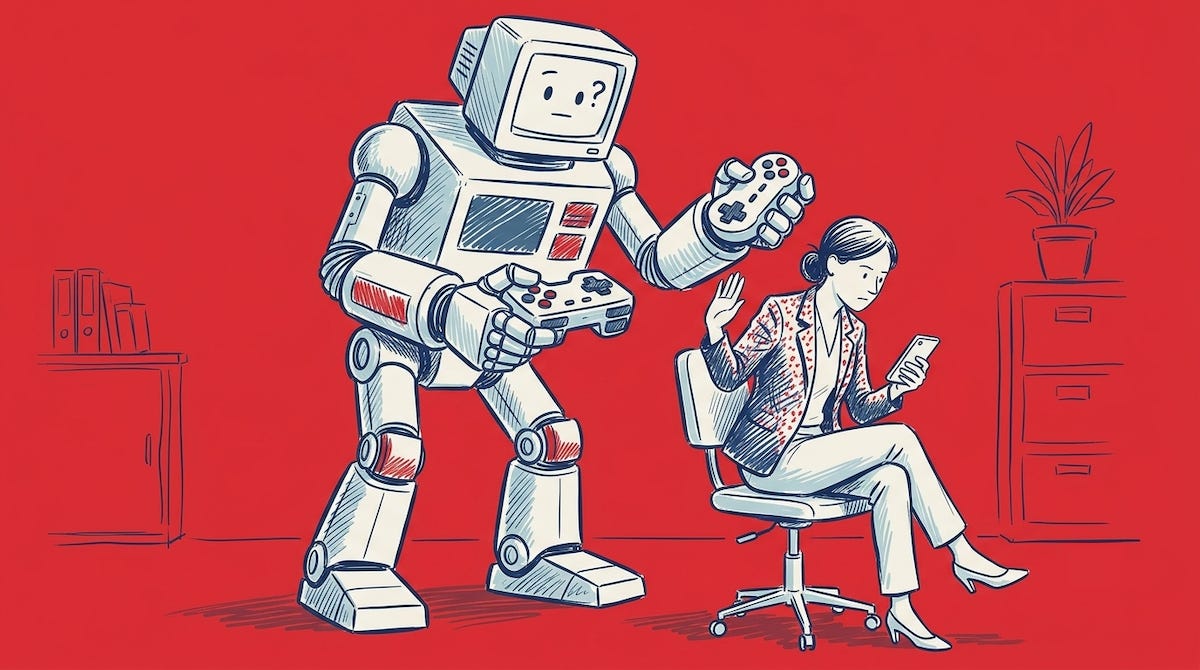
Hogging the controller
These reasons echo traditional corporate IT headaches. Every organisation lives their own version of “SharePoint hell”: no folder discipline, documents versioned into oblivion (has anyone ever used a Word template?), and the one colleague who knows everything seems to be on a permanent holiday.
These challenges mark the tension between the employee as an individual and the employee as a cog in the machine. Systems, templates and shared tools serve the machine. Workarounds and hoarded knowledge serve the person. Most people have worked out that being indispensable beats being interchangeable.
“Every organisation lives their own version of ‘SharePoint hell’… team members hoard knowledge so they are missed when they go on holiday”
Corporate IT — whether AI or SharePoint — makes work visible, measurable and therefore replaceable. Given the choice, team members will choose to hoard knowledge so they are missed when they go on holiday.
Boss-level actions
Understandable as these reasons may be, it is a leader's job to ensure that teams are aligned and standards are followed. Hard tactics like policies and stern words have their place. But before you furrow your brow, consider these three tactics:
Make AI a safe space.
Set clear AI policies stating plainly that, unless deliberately shared, conversations remain personal. Communicate this explicitly, as employees will assume they are being surveilled until told otherwise.
Make it really useful.
“Productivity multiplier” sounds like cramming more work in. Teams adopt a tool that tips work-life balance in their favour. Pitch AI as a tool for teams to find and create stuff faster, so they can pick up the kids on time.
Make it accessible.
The company AI must live inside the everyday tools — inbox, team chat, calling, code repos. Every new tab and separate password is a small vote for the personal Claude account.
“To ensure adoption, you need a mix of policy, education and design”
As a leader, you might think these things are self-evident. But the tension between the individual and the company creates expectations, all of which are encompassed in corporate AI. To defeat these expectations and ensure adoption, you need a mix of policy, education, design — and patience.
Closing thoughts
It is true that teams snub corporate AI, but that is a matter of psychology rather than laziness. Employees already use the technology daily and enthusiastically; they simply dislike the company version.
The pattern is familiar and is linked to individuals’ need to protect their position inside a system designed to make them interchangeable. Leaders can try to force their will, but the ubiquitous SharePoint hell is evidence that this is unlikely to work.
Instead, start by making it safe, so teams can experiment without being watched. Make it useful, pitching productivity gains from the individual’s perspective. Make it accessible so that the company AI is more convenient than the unsanctioned one.
Corporate AI often treats workflows as multiplayer gaming: loud, performative and scored. Most people, however, see their work as doing the Wordle. Sanction that, and they might stop sneaking off to play elsewhere.