


“Let’s be real: the current marketing landscape is fundamentally failing to deliver value. 📉 We need a paradigm shift. Who’s ready to disrupt the status quo? 🚀 #MarketingStrategy #GrowthHacking #Innovation #Leadership”
With a wave of its probabilistic wand, Kagi’s English-to-LinkedIn-speak translator turned my title into rubbish. Cliches, hashtags and calls to action were mushed into algorithm fodder. We hope the post will get a boost and reach the right prospect at the right time.
For years, this has been the typical marketing playbook. We give the algorithm what it wants, and it gives us a share of attention. We allow it to crawl our content, in return for traffic. We optimise for attention, and worry about the message later.
It was rubbish, but it kinda worked. Now it’s still rubbish, but it’s also broken.
I. Social is losing its reach
In late March, Meta and YouTube were found liable for harms caused not by their content but by their design: infinite scroll, autoplay, push notifications, etc. As the Platformer argued, the reasoning is significant. The same content delivered with a little friction means fewer people are harmed.
While this is good news for consumers (and certainly for parents), it presents a challenge for brands. The mechanics being contested are the same that power paid social advertising. If platforms are forced to dial back these features, their reach will shrink. With daily active use declining across most major platforms, the era of reliable organic reach may already be behind us.
Algorithmic strategies have been losing their potency for a while, but we are fast approaching a point where social media marketing yields diminishing ROI.
II. AI is not an ally
Meanwhile, OpenAI is bent on repeating Meta’s mistakes by trying to monetise our attention with adverts. An OpenAI researcher resigned on launch day, warning that advertising increases the risk of manipulation. An AI assistant, paid for by advertising and with a built-in tendency toward sycophancy, will not act in its users’ interests.
Worse, AI bots are now hogging traffic. Traditional search would crawl your content in exchange for sending you traffic. But as the CEO of Cloudflare pointed out, AI chatbots capture and retain a significant share of internet traffic, effectively competing with your brand for attention.
So just as traditional social channels wane, the ones taking their place are not only prone to similar problems but also blatantly stealing your traffic.
III. Slop machines
Even if the channels were stable and benign, they are still designed to encourage rubbish content. Om Malik convincingly argues that the organising principle of information has shifted from authority to velocity. Algorithms reward speed, not truth. The three-month product review, written after actually living with the thing, is buried by the day-one hot take — not because it’s worse, but because the algorithm has moved on.
Will Quist takes the argument further, claiming that traditional comms is dead. Platforms enabled brands to speak directly to their audience, but when everyone can go direct, noise explodes. When the objective is to get a million followers, your job is to produce more rubbish than the competition, faster.
AI makes this a lot worse. As post-training optimises for safety at the expense of originality, AI’s creative writing abilities have barely improved. AI is a superb editor: it will tighten your structure, catch your errors and adapt your content for different formats. But as an author, its output is unoriginal, derivative and soulless.
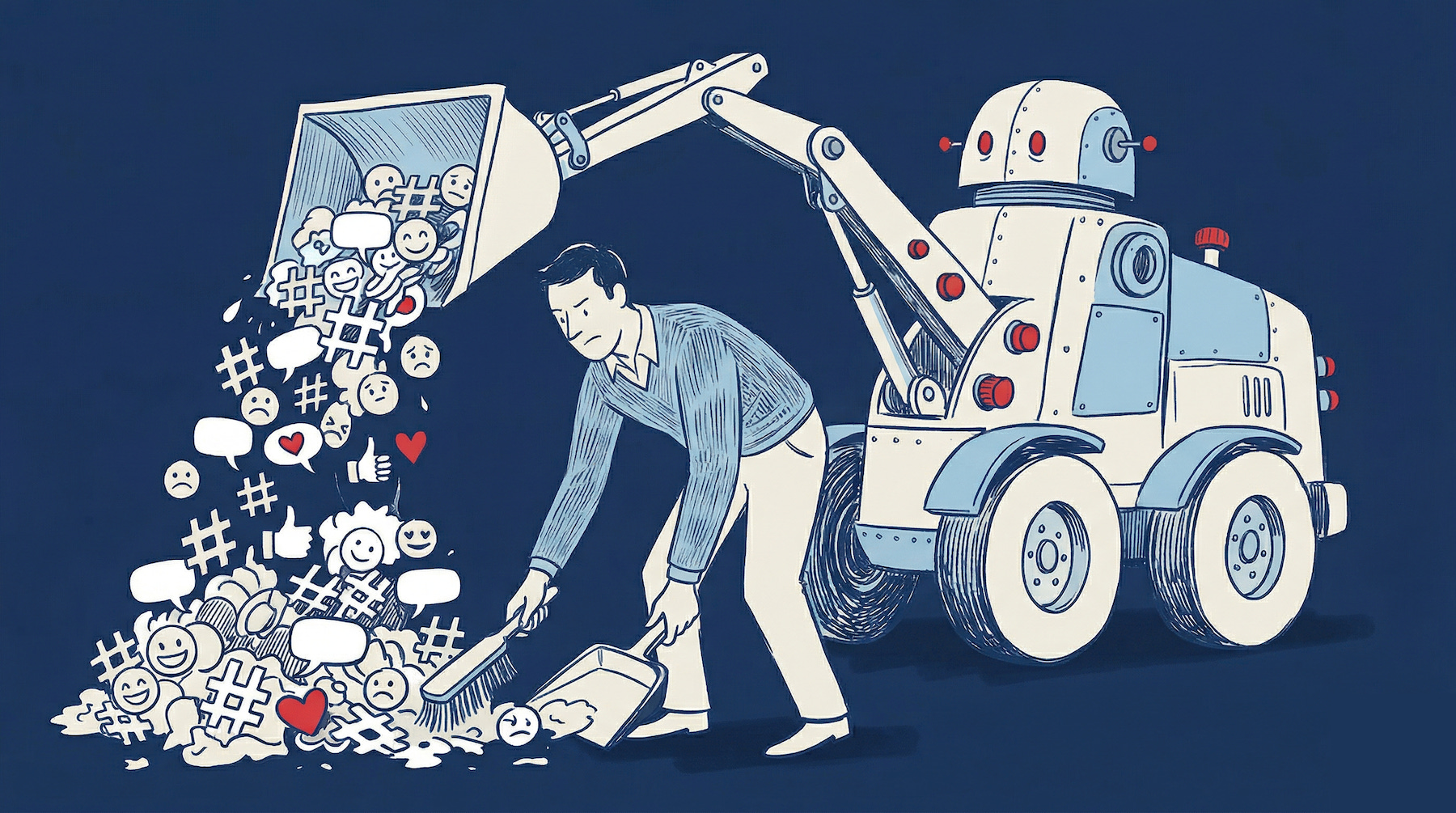
The algorithm demands feeding, and generative AI obliges. No wonder marketing feels like everything, everywhere, all at once, is slop.
IV. Can we fix marketing?
1. Write for people
Write content for humans: specific, credible, creative. Write about what you know: the actual challenges your customers face, the trade-offs you have navigated, what worked and what didn’t. Use AI to edit and sharpen, but make sure the point of view remains yours. Write a post for 500 decision-makers to read, rather than for 50,000 users to scroll past.
2. Use AI to syndicate to AI
The top of the funnel (SEO, AIO, social reach) is a bot-to-bot conversation. Write for humans and use AI to generate the variants, social previews and FAQs that search engines and AI bots can parse. AI may be an unoriginal author, but it can be an excellent translator between your ideas and the structured formats preferred by channels.
3. Own your channels
The old platforms are weakening, and new ones are not your allies. It is time to diversify into owned channels such as curated email lists, communities and direct relationships. Renting your audience from a company that is competing for your traffic is not sustainable. Bring it in-house, and every lead, subscriber and prospect you own is a relationship you can develop.
V. Closing thoughts
In the age of AI, the human element stands out. AI can sharpen your copy, but it cannot build trust on your behalf, nor tell your story with any conviction.
Marketing is still the art of crafting signals that resonate with the right audience. Yes, it is noisy out there. But you can no longer hope to cut through the noise by adding some noise of your own.
Put another way:
“Content without substance is just digital clutter. 💡Focus on the message. Focus on the impact. The rest will follow. 🚀 #ThoughtLeadership #MarketingStrategy #BrandPurpose #ValueFirst #BusinessGrowth”
Further Reading
Platformer — Can you have child safety and Section 230, too?
Om Malik — Velocity Is the New Authority. Here’s Why
Will Quist — Beliefs Outrun Facts
The Atlantic — The Human Skill That Eludes AI
SXSW — The Internet After Search (video)