

Substack caused a stir by integrating Pangram’s AI detector into the platform. Some users called it a witch hunt. One writer wrote her farewell post entirely with AI and watched Pangram score it 100% human. You have to laugh.
The min-saga made me think about my own writing process. Why do I write this newsletter, and where does AI fit in my process? More broadly, why is using AI for writing so emotive, and will it get stigmatised?
I write as I want to be read
Reading is the one part of my writing process I take my time over. I consume a huge amount of journalism: books, newspapers, magazines, newsletters, podcasts. I read to learn, but also because I am interested in the author’s intent — what they want to communicate — and in the subtext, i.e. why they take that position and how they came to it.
Posts written entirely by AI tend to strip all of that off and come across as colourless. I write this newsletter the way I want to be read. I want you, the reader, to understand my intent and get a glimpse into my thought process. Whilst I would not be able to maintain a weekly publishing pace without AI, my workflow needs to ensure that this connection remains intact.
My writing workflow
Writing begins where the reading stops. I open a Claude Project built around this newsletter, upload a pile of links and a vague, half-formed idea of where I might be going. AI is great at finding common threads and spotting inconsistencies, and after a few turns, a structure emerges. It is almost always wrong.
I return to the sources and check the narrative against my perspective and strategy. Half the time, I go back to the drawing board because the story is too weak or has the wrong frame. Either way, I do not move on until I am happy I can express my thinking clearly.
Claude produces the first draft, using embedded instructions that include my preferred tone of voice, structure and dos and don’ts. My prompts can run considerably longer than the final post, but after a few turns I have my first candidate.
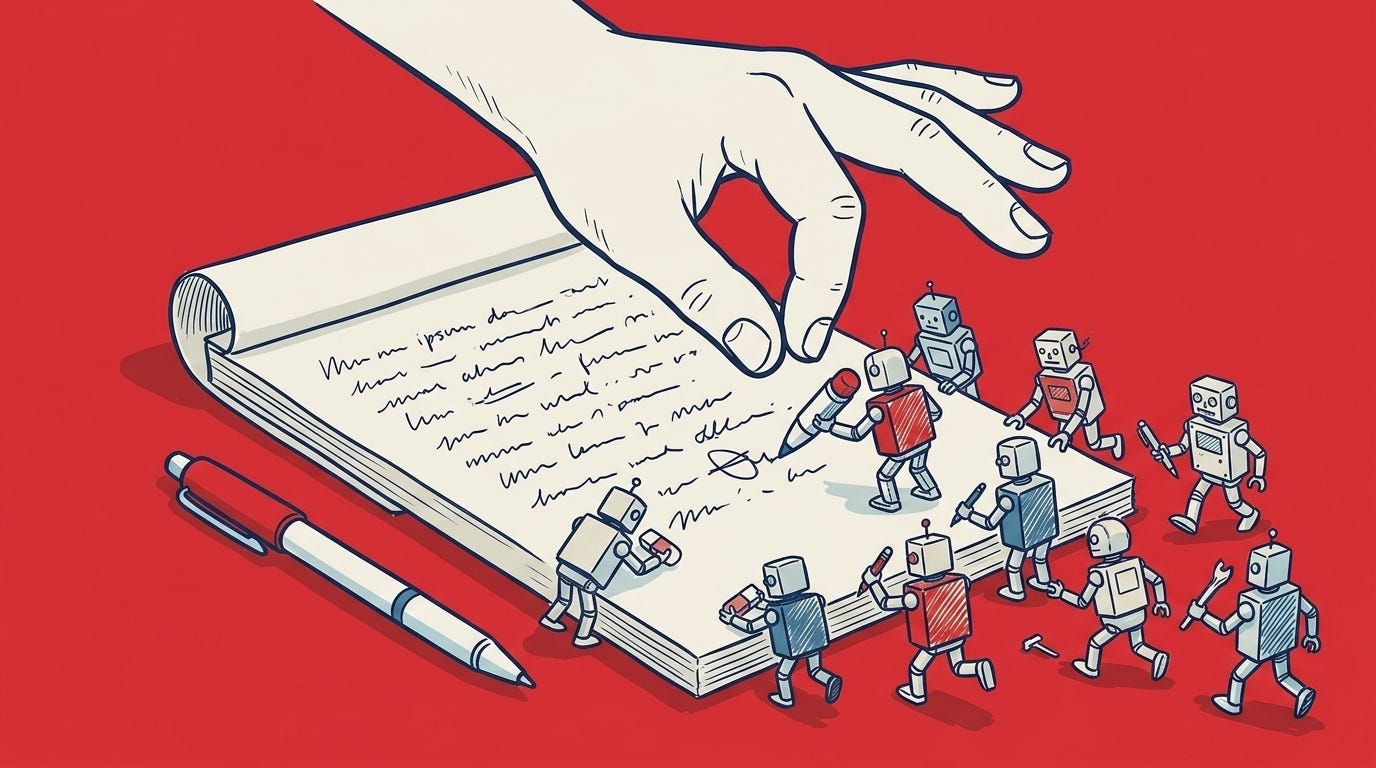
Over on Substack, the draft gets heavily edited to align language and structure with my intent. I then get creative, looking for a memorable title-image combination (something the AI has never got right). The image is rendered with Gemini based on a hand-drawn original illustration and colour palette.
I check the language with Grammarly and the facts with Gemini before hitting the Publish button. Social posts I write by hand because the effort is manageable and you can only cut through noise by adding a bit of personality.
Why is AI writing so emotive?
The conversation about AI-created content and authenticity goes beyond Substack. Ed Zitron, who considers the entire industry a death cult, has a point when he says we are embarrassed to let people know we are using AI, because we are admitting we are outsourcing our thinking to a machine.
As a result, we are getting performative about proving that content was not written by AI. My posts come back 100% human as well, which I will admit is rather satisfying. Having said that, I am aware that anyone determined to pass can keep editing until they do so.
AI detection is most useful as a signal of quality. Pangram’s CEO explains that their model is looking for signs of overoptimisation. The labs tune their models for “correct” writing, code and correct maths, and the detector picks up on these tells. I would not want to pay for overoptimised content, as the machine always smothers the author’s intent.
Will AI content be stigmatised?
Google, an old hand at dealing with overoptimised content, agrees with me. Their positioning has not substantively changed since 2023: reward quality and intent, irrespective of method of production. Google does not care who wrote the content, so long as it does a decent job of communicating to a human.
However, marketers should note that customers are not as relaxed. In a survey, 79% of responders say they would rather deal with a human agent, and 84% believe humans are more accurate than AI. Advertisements labelled as human-made earn more trust and purchase intent than those labelled as AI.
As the volume of meaningless AI-generated content increases, labels such as “100% human-made” and “No AI used” will get more common. That will be an overreaction. Using AI in writing is not a binary decision, and the appropriate amount depends on the reader’s needs.
Finding your balance
The right amount of AI in writing depends on how much intent matters. In a novel, intent is the whole point. The reader wants to connect with the author, so using AI naturally feels like a betrayal. Coffee machine instructions, on the other hand, can never be too optimised: the reader would thank you for minimal connection.
Tech newsletters sit in between. Developments happen so quickly that an author who ignores AI has no chance of keeping up with the trends. However, the whole point of a newsletter is to connect with readers, so you must use AI very selectively.
The prompt for this 984-word post ran to 829 words. Worth every one.
Further reading
Simon Hernandez-Arthur, Substack bets readers want to pay for content written by humans, Axios
Emanuel Maiberg, Substackers Say New AI Detection Tool Is a ‘Witch Hunt’, 404 Media
Kelly Webb-Davies, This post was written by AI
Kevin Roose and Casey Newton, Zuckerberg’s Anti-Doom Fantasy + Finally an A.I. Detector That Works + A.I. Math, Hard Fork
Ed Zitron, The AI Hater’s Manifesto, Where’s Your Ed At
Google Search Central, Google Search’s guidance about AI-generated content and the March 2024 core update and new spam policies