

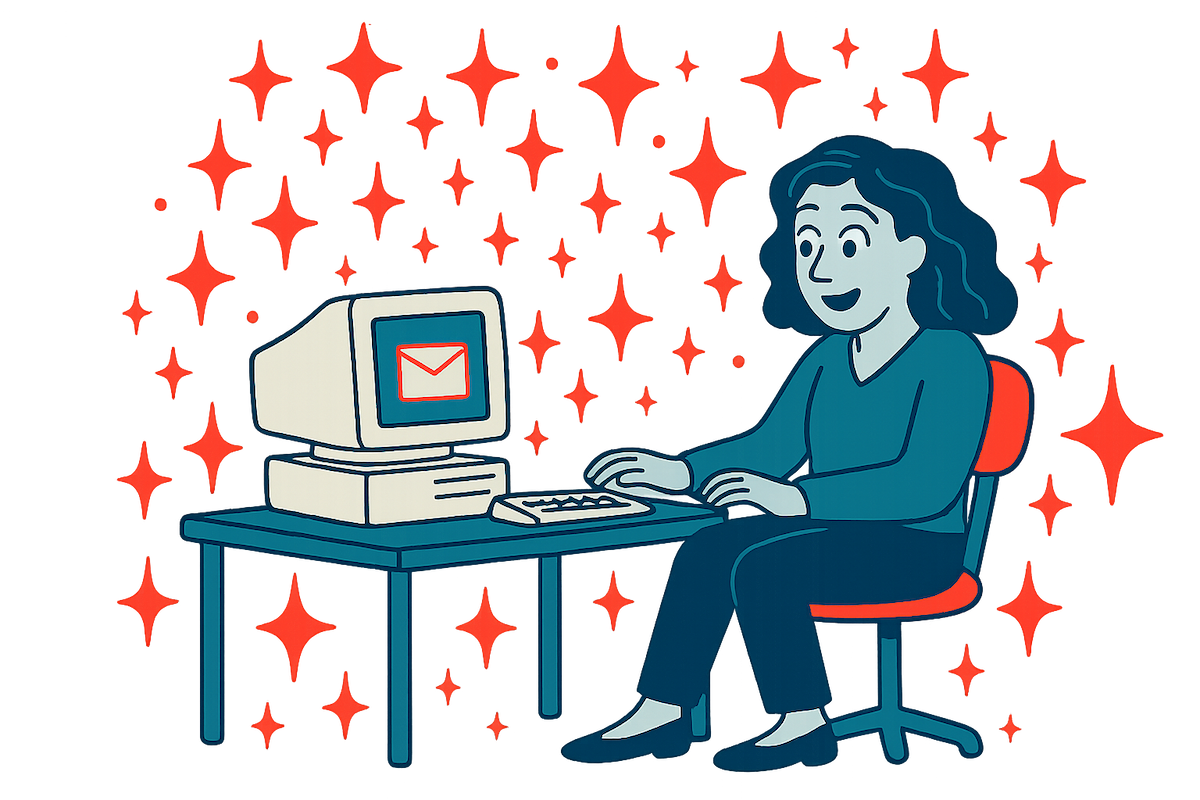
The year is 1996. Hotmail has just launched, and a (much) younger me is trying to land his first freelance website design job. The prospect is the Managing Director at a mid-sized manufacturing firm, a family friend. He is curious but sceptical. “We are a small business, and there is so much going on. What will a website do for us?”
Roll forward to 2026. ChatGPT is already 3 years old, and a (much) older me is trying to convince my clients to go beyond the basics with AI. The prospects are leading ambitious SMEs, some of whom have trusted us with their digital for years. They are also curious, but sceptical.
“We are a small business, and there is so much going on. What will AI do for us?”
I. Is this really a good time?
The Economist reports that, as of Q4 2025, business AI Adoption is stalling or going backwards. As Big Tech needs to recoup its monstrous infrastructure investment, this is a concern. Flatlining business revenue threatens a sudden market correction and a more prolonged recovery.
Many SMEs are highly sensitive to economic sentiment and are growing increasingly nervous about the AI bubble. Add to that an unsettled geopolitical environment and footloose customers, and it’s no wonder that all leaders are thinking, “Is this really a good time?”
Back in 1996, even the companies that did not “get” the internet understood that not having a website was a signal of stagnation. In 2026, we will emphasise that an AI roadmap is a signal of dynamism.
II. How can AI help my business?
For large organisations, AI use cases are pretty obvious: with large teams, diversified revenue streams and abundant data, even modest productivity gains can have a massive impact. But SMEs operate on a minor scale and have sparse datasets, so we are often asked: “What can AI do for us?”
My advice is to start at the point of conversion and work outwards. The sharp end of the sales funnel is often intense, personal, complex and data-heavy, making it a good place to start. Next, personalise your marketing, remove onboarding friction and automate customer support. Done with those? Use AI to improve cross-team workflows, build new revenue channels and imagine new products.
Back in 1996, I did not sell “digital transformation” but “websites”, easily understood as “online brochures”. In 2026, we will drop the “AI transformation” talk and pitch a “growth machine” that helps SMEs gain and retain customers.
III. Will the team use it?
Your team is scared that AI will take their jobs. Whether the fear is justified or not, it’s almost certainly there. Team members are also unsure about security, ethics, copyright and whether they will be punished or rewarded for using AI. Large companies can rely on HR departments to coordinate uptake, but SME leaders often ask: “Will the team use AI?”
The question is understandable, but a little moot. Team members already use AI, but in an uncoordinated, unsanctioned, defensive way. It is the CEO’s task to publish a corporate AI policy, to ensure teams are trained to use AI safely and productively, and to foster a culture that rewards both creativity and efficiency.
Back in 1996, teams were nervous about relying on “computer whizzes” for creative things like sales and marketing. In 2026, we will help leaders pitch AI as a tool that will make work easier, not redundant.
IV. Isn’t it terribly complex?
Many SME leaders approach AI projects with either too much respect (”We must integrate all the systems”) or too little (”Can’t we just point an LLM to some PDFs?”). Neither approach helps: the first often results in paralysing complexity, the second leads to shallow or unsafe solutions.
SMEs need to approach AI iteratively, building capabilities and ambition incrementally. Early on, we can use full-stack apps to create momentum. Later, more robust and supportable solutions will help build confidence. Eventually, flexible and extensible solutions will help them scale out to wider business value.
Back in 1996, I did not offer “digital experience platforms”. Clients would give me a Quark file on a Zip drive, and I would convert it to a website. In 2026, we will also start with full-service solutions, using whatever data is “lying around” to get things moving.
V. 2026: it’s 1996 all over again
Back in 1996, my first sales pitch worked, despite - or maybe because - it lacked any grand vision. The proposition was simple: you don’t really understand the internet, but you know you need to be “on” it. Neither of us really knows how this will play out, so instead of wasting your money, I will take your current stuff and get it “online”.
Later on, we made a distinction between that initial digitisation stage (the process of converting print brochures to websites) and the digitalisation stage (the business remodelling for the digital domain) that followed. Back in 1996, we called it fake it till you make it. In 2026, to help SMEs get on with AI adoption, we need to dust off that old playbook:
AI will signal dynamism, and you will need a credible roadmap to help you develop capabilities at a steady pace.
Start with AI for Growth, and expand across the customer lifecycle, from sales and marketing to onboarding and servicing.
Reassure your team that, far from being replaced, the intention is to make them more effective and essential.
It’s OK to start small with self-contained apps and existing datasets, with a view to scaling out over time.
SMEs are ignoring AI because AI is ignoring them. As model-makers rush to release ever more powerful models, they forget to build reliable, business-friendly tools. The markets may indulge their obsession with nonsense like AGI, but stalling adoption can bring the whole thing crumbling down.
Back in 1996, we did not know how fast this could happen. In 2026, we should know better.