


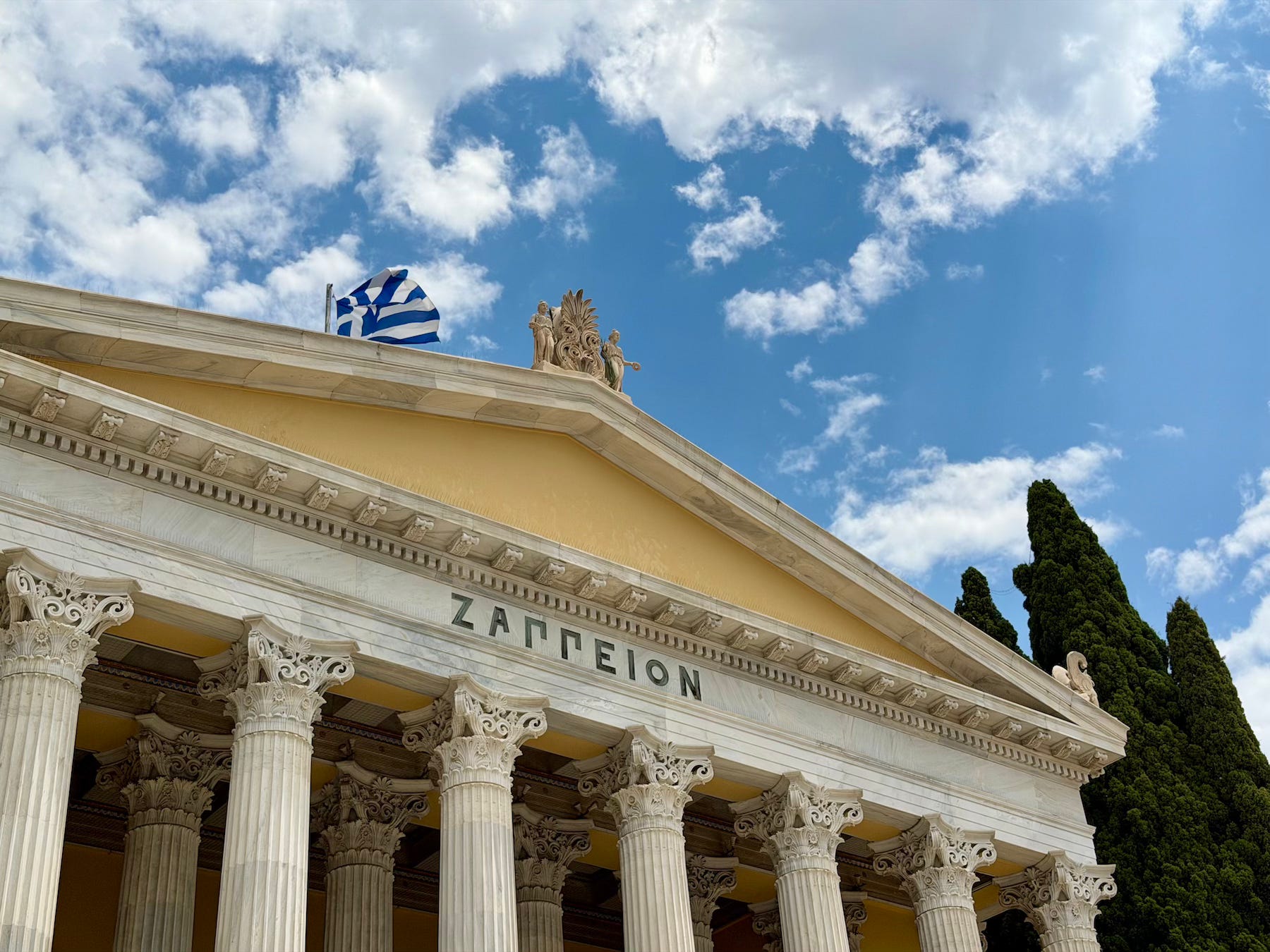
“Value”, “innovation”, “tech”, “capital”, “founder”. Under the bright Athenian sun, even the most worn-out startup phrases had a different flavour.
At the Panathenea conference last week, speaker after speaker shared their experiences and insights with an audience of entrepreneurs and investors. The city — still recovering from severe economic turmoil — served as a timely reminder of how quickly global threats can escalate.
The common thread of discussion was how to innovate as AI becomes the hidden infrastructure. As LLMs get commoditised, advantage lies not in tech but in physical products, distribution and trust. Which is just as well: faced with a growing backlash, many companies will prefer to keep AI under the bonnet.
What you need to know
As AI turns to hidden infrastructure, advantage comes from distribution and relationships
The AI backlash is moving mainstream and becoming a consideration for any brand leading with AI
Running in polycrisis mode for years, Greece is a useful model for European tech priorities
Capital moves to the extremes: hard tech in robotics and defence, and softer propositions in regulated sectors
Wish you were here
Microsoft’s Ulrich Homann reminded us that technology is not the same as transformation. Layering AI on top of disconnected processes will not fix them. Most companies, he argued, focus on the tool and miss the business change entirely. AI strategies focused on capabilities alone will never succeed.
Distribution and relationships were mentioned repeatedly. Owning the customer relationship is the real moat — not the product, not the AI, not even the data. Xero already owns accounting relationships across multiple markets. An AI capability built on that base is harder to dislodge, a point not lost on the CEO of Attio, an AI-native CRM.
There was a shift in tone from user experience to proven trust, as manifested in brand perceptions and regulatory assurance. Gradient Labs is building compliance infrastructure for regulated institutions on the premise that compliance is a trust signal.
This can well play to Europe’s advantage. We need not outspend the US, but our startups are well-versed in cultural and regulatory diversity and well-placed to go global.


Meanwhile, outside the bubble
Discussion of the growing anti-AI sentiment was conspicuously absent. Two weeks earlier, Eric Schmidt was booed when he brought up AI at a graduation ceremony. At least three commencement speeches this season received the same reception the moment AI was mentioned. When a speaker noted that “only a few years ago, AI was not a factor”, the crowd cheered.
AI has a real and urgent trust problem with the generation that will staff, manage, and purchase the products we are discussing at the conference. In Athens, panellists touched on trust repeatedly as a business challenge. But they chose to forget that the trust deficit is focused on the generation that is supposed to be its fastest adopter.
For businesses leading with AI face more than a PR backlash. The same tech that signalled an innovative edge last year now signals indifference to job displacement and data centre sprawl. In the eyes of many young people, AI is no longer compatible with purpose-driven enterprises.
Greek lessons
Growing anti-AI sentiment is not the only thing the panellists missed. Youth unemployment, extreme climate, unpredictable neighbours and an economy slapped around by global pressures have been the Greek reality for years. The signs of turmoil and renewal are a sharp reminder of why European innovation must accelerate.

Creativity and experience are important, but the quality that capital is looking for right now is urgency.
Northern Europe is only now arriving at these questions. Of course, Poles must also spend heavily on defence, Spaniards are also dealing with extreme heat, and Italians have to tackle youth unemployment too. But Greece, at the centre of the polycrisis Venn diagram, knows a thing or two about finding your way out.
Whilst all this was lost on the stages, it was evident in the networking tent, where founders and investors met, sparred and cut deals. Amid the buzz, I sensed an ecosystem ready to take on the most pressing challenges. Creativity and experience are important, but the quality investors look for in founders right now is urgency.
Capital controls
So, what are investors interested in? SaaS is out of fashion, as the market anticipates consolidation and therefore fewer exit opportunities. Instead, capital is following an hourglass shape, concentrating on the extremes of hard tech and soft inclusivity.
SaaS has fallen very much out of fashion. Capital is concentrating on the extremes of hard tech and soft inclusivity.
At one end, money is flowing into hard tech — defence, robotics, energy — where AI is an enabling component inside a physical-world solution. Dexory is solving warehouse visibility with sensors that have dropped in price from $20,000 to a few hundred dollars. Investors were attracted to fixing in supply chain fragility, not to whether or how AI is used.
At the other end, money is moving toward trust and inclusivity: financial well-being, access to employment and healthcare. Plum is building a fully digital financial advisor for those who feel neglected by traditional financial advisors. In this trust problem, AI can certainly help, so long as it stays tucked under the bonnet.
Platonic ideal
Startup conferences always attract a good deal of energy and optimism, and Panathenea was no exception. I came out with three takeaways for founders and business leaders:
Focus on fundamentals. Distribution, customer relationships, and brand trust are the moat. AI can amplify existing advantages, but it cannot create new ones.
Take the spotlight off AI. There is nothing to gain from talking up your AI prowess. It is a distraction in hard tech and an obstacle to trust building.
Find urgency in what you do. The Greek lesson is about innovating your way out of a crisis. Urgency is what both customers and investors are looking for.
The startup competition evidenced these learnings. It was won by Gigpossible, a platform that matches workers with high-quality employment. Of course, they use AI, but the spotlight was firmly on the stories of those exploited in the gig economy.
Following the pitch, a London-based judge confessed their lack of local knowledge and asked the audience if they agreed the need was real.
Hands shot up. The company was clearly solving a real and urgent trust issue. The prize was settled.
Further Reading
Eric Schmidt booed during commencement speech — SiliconAngle
AI Index 2026: Public Opinion — Stanford HAI
Europe’s defence and resilience startups hit $8.7bn — Vestbee
The Great Digital Disconnect — Centre for International Governance