

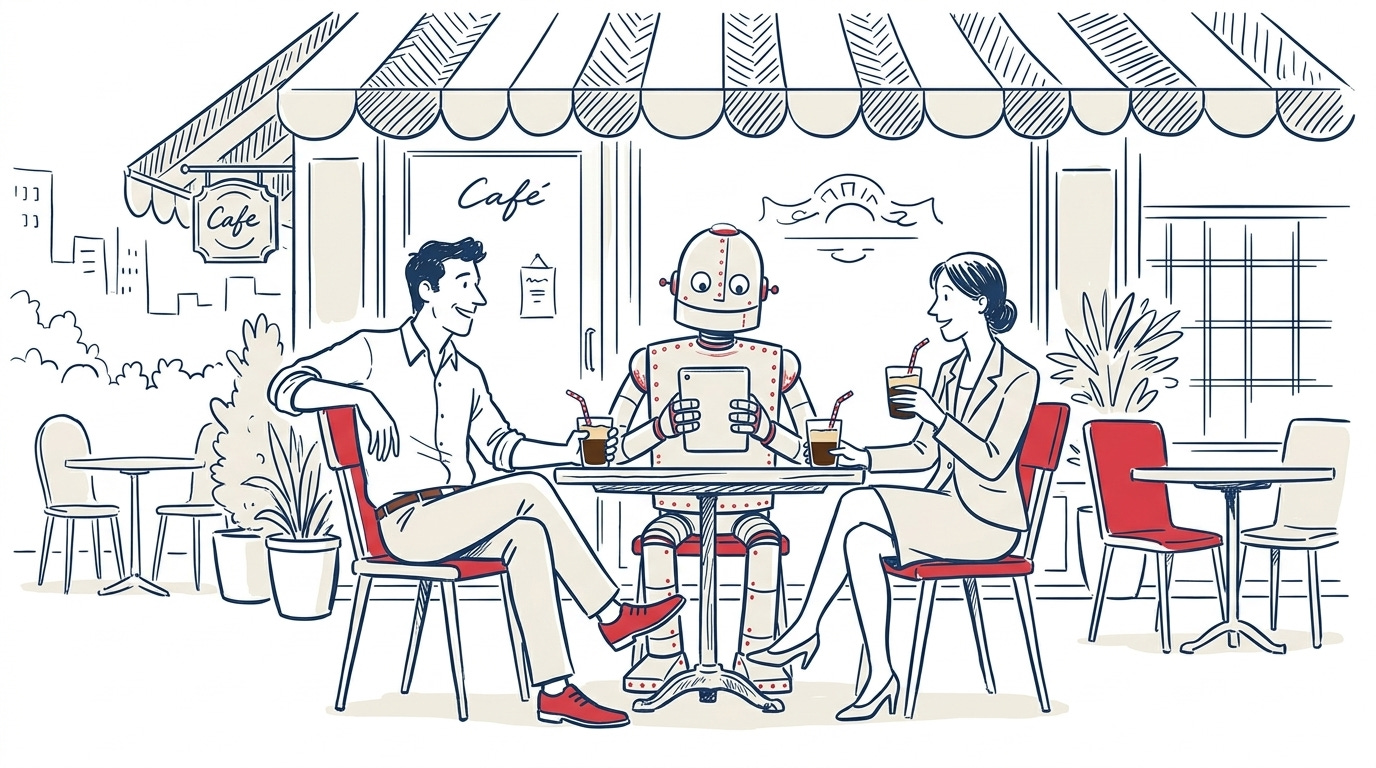
In Greece, a great deal of business gets done over a Freddo Espresso, a frothy concoction of espresso and ice. Chilled, strong, and pleasantly bitter, it is perfectly suited to the kind of conversation where trust is built and things are decided.
This isn’t just a cultural quirk or a pleasant pause in the working day. In a world where AI is automating outputs, the conversation over coffee is not a break from the work: it is the work.
The Freddo Espresso hypothesis posits that connections – not documents – are the natural habitat of value, and that AI can help us return to that concept of work. This has three implications for business leaders: (a) measure outcome instead of output, (b) build conversation into workflows and (c) reward profitable connections.
I. Are we working harder?
It turns out that AI is making us work harder. This is not what was advertised. We were promised more time to think, plan, and focus on valuable work. What has largely happened instead is that if a task which used to take a week now takes a day, we feel compelled to take on five of them.
This pattern is called the Jevons Paradox: as a resource becomes more efficient to use, consumption tends to rise rather than fall. When AI made written output dramatically cheaper to produce, organisations did what they have always done with cheaper resources: demanded more.
To unravel this paradox, we first have to ask: why are we writing so much stuff for work?
II. The pandemic primed us for AI
When offices emptied in 2020, the visible signs of productivity disappeared almost entirely. What remained was the artefact: the slide deck, the briefing note, the strategy document.
Documents became the primary unit of professional output. If the boss could not verify you were working, they could at least check your output. Those habits persisted, and for many professionals, documentation became the “real work” that calls and meetings often distract us from.
When ChatGPT landed in late 2022, we were primed to love it. Once you have internalised work as the production of text, a technology that generates text fluently feels like magic.
AI became the fastest-adopted technology in history, partly because of its capabilities and partly because of its timing. It automated document creation at precisely the moment we had convinced ourselves that “work” was all about writing stuff.
III. The value is not the doc
That trend is now reversing, as we realise that volume is only an advantage when it's difficult to achieve. When every team at every organisation can produce a detailed market report in an afternoon, that report is no longer a differentiator.
AI drains the value out of documentation, not only because it costs nothing to create, but because it was never really where the value lived. The document was always a means to an end, designed to start a conversation, to bring a room to a shared understanding, to create the conditions for a decision.
For a while, we confused the work with its documentation. But as AI automates writing, value migrates back to the human connections: the meeting that inspired it, the presentation where it landed, and the conversation about what to do next.
IV. Grab a seat
The most profitable human connections rarely happen in structured work sessions. They happen in conversation with colleagues, clients, and partners, in exchanges where ideas are challenged, refined or redirected by someone who brings a different perspective.
AI is good at stress-testing and surfacing gaps in our thinking, and that is genuinely useful. But a trusted sparring partner who tells you that your entire framing is wrong — as that second Freddo Espresso kicks in, perhaps? — is doing something that takes years of accumulated trust.
These relationships cannot be “prompted”. They take time, presence, and a willingness to have conversations that aren’t directly tied to a deliverable. For businesses, these connections are the real sources of value.
V. Takeaways for leaders
AI is great because it can create space for those conversations. For managers and leaders, this has some practical implications worth acting on now:
Review how performance is measured. Ask whether your current metrics reward output or outcome. AI sharpens the distinction, and OKRs built around deliverables may incentivise the wrong behaviour.
Build conversations into workflows. Ask whether you have allowed time for substantive conversation and deliberation between deadlines. If not, it may be crowded out by our instinct to use saved time to cram in more.
Rethink what you reward. Ask honestly whether your incentives reward building relationships. If you value them, make sure you recognise their contribution during performance reviews.
Documentation is merely a carrier of value, not its source. Using AI to create documents faster, only to spend that time creating more documents, is a waste of human energy. Worse, it results in higher-intensity work but lower productivity.
After AI writes your document, resist the temptation to cram another one in. Instead, go and discuss it with someone. The real work begins as you stir that Freddo Espresso.