


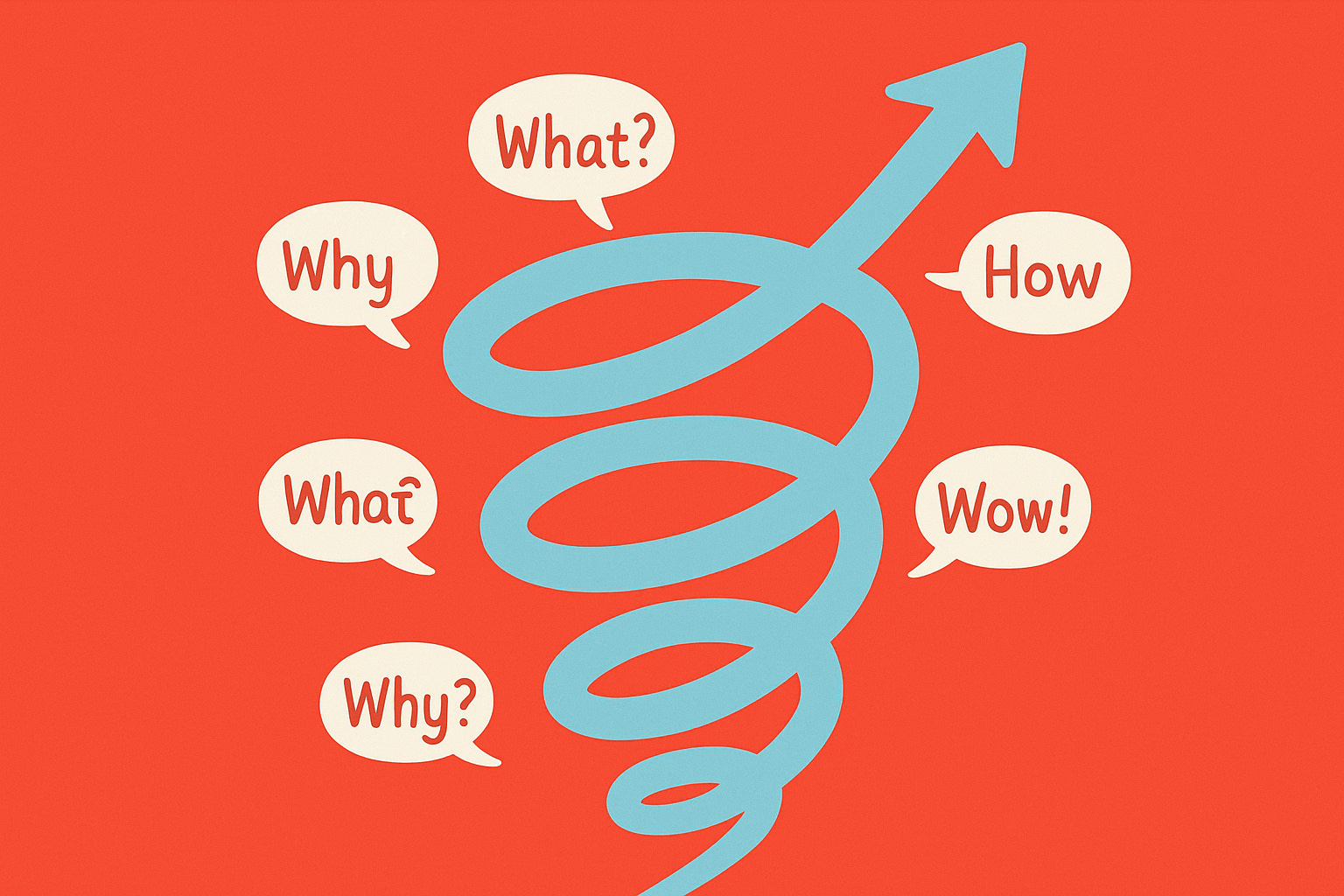
One of my key observations from the TED AI conference is that innovation rarely unfolds in a linear manner. The familiar hype cycle from Gartner depicts innovation coming in waves that follow a predictable path.
The analogy is tidy but misses the recursive way that new ideas take hold, an arc that starts with awe and returns with the seeds of renewed ambition. This is the Innovation spiral, a repeating pattern of wonder, reflection and exploration that captures perfectly the rhythm of our age.
“Wow!”, or the Spark of Wonder
Every era has its “Wow” moment. Those breakthroughs that capture public imagination and make the leap from science to everyday conversation. The launch of ChatGPT was such a moment. The idea that machines could write, converse, and even create images felt almost magical. Awe brings attention and energy, dominating conversations at dinner tables, boardrooms, and classrooms.
”How?”, or the Race to Build
How does this work, and how can we improve it? From recurrent neural networks and transformers to reasoning and reinforcement models, technology keeps evolving. This phase is restless and competitive, as scientists and engineers probe the limits of what is possible. The pace of progress can be staggering, even exhausting.
“What?”, or the Quest for Value
The technology itself is rarely a revolution. The real question is: what do we do with it? What will create genuine value for people and businesses? This is the stage where models give way to applications and experiments become products. In this stage, inclusivity must be a guiding metric: an instrument for widening access, not deepening divides. In the “What” stage, we learn whether wonder can yield utility.
“Why?”, or The Pause of Reflection
Innovation is not a forward-only motion. Pausing to ask “Why?” may be the most critical stage of them all. Here, we step back and seek the reasons we are building these systems. Is AI merely a tool for task automation (and labour displacement), or can it also be a tool for thinking? At this stage, artists and designers envision a future where innovation empowers us, rather than sleepwalking us into dystopia.
“Why Not?”, or the Next Frontier
But why stop here? Why not pursue quantum computing, neural interfaces, advanced robotics and even machine consciousness? The “Why not” phase is the key to the next cycle, the next wave of wonder. It can be speculative, but it is essential because it seeds the imagination of future scientists and entrepreneurs. Without “Why not?” today, there will be no “Wow” tomorrow.
Balancing momentum and purpose
Innovation is often framed as a story of soaring expectations, disillusionment, and a crawl back to productivity. That story misses the deeper rhythm at work: breakthroughs spark wonder, which drives furious building, which yields new applications, which invite reflection, which provides the seed for the next breakthrough.
Almost three years after the launch of ChatGPT provided the “Wow” moment for AI, the “Whats” are coming thick and fast, and the first “Whys” are beginning to appear. At this stage, we need to remember that reflection is not a brake but a compass and that the spiral of innovation needs both momentum and purpose to move things upwards.