


The other day I was trying to make sense of a thorny business problem. A number of proposals from apparently great prospects did not go our way. Where did we go wrong, and how could we fix it?
I collected the relevant material and asked AI to summarise and explain. Unprompted, it offered an in-depth diagnosis and solutions. I could have stopped there, but for the nagging feeling that something important had been lost: the questions I never got to ask.
The point is timely. Last month, more than two dozen Fields Medallists signed an open letter arguing that AI labs racing to solve problems have lost sight of why those problems matter. The solution, they argue, is less important than the questions encountered along the way.
Put another way, we don’t climb mountains for the selfie, but for the twists and turns along the way. For everything that matters, the journey is still the destination, and AI is merely a companion.
Key idea
AI gets to a plausible answer in minutes, which makes it tempting to delegate the whole problem. That doesn’t work with strategy: the context is incomplete, and requirements are subject to change. Adapt the Double Diamond framework to blend AI, team feedback and intuition in your decision-making process. The time saved on the answer is small next to the cost of the questions you never got to ask.
The problem with AI decisions
AI is a powerful but limited solution machine. To begin with, it is always missing at least some context. Documents, call transcripts and emails are never the complete dataset. Informal conversations, body language and legacy documents are all lost.
Designed to shorten the time to solution, AI misses rich opportunities to explore the problem. Even when it appears to push back, it tends to tell us what we want to hear. True pushback challenges the premise and takes time to explore the problem.
Finally, the convenience of arriving at a solution can blunt our ability to think critically. In a recent survey, researchers found that confidence in AI correlates with a decline in critical thinking. Business leaders must use the technology to sharpen their decision-making rather than delegate to it.
A decision-making framework
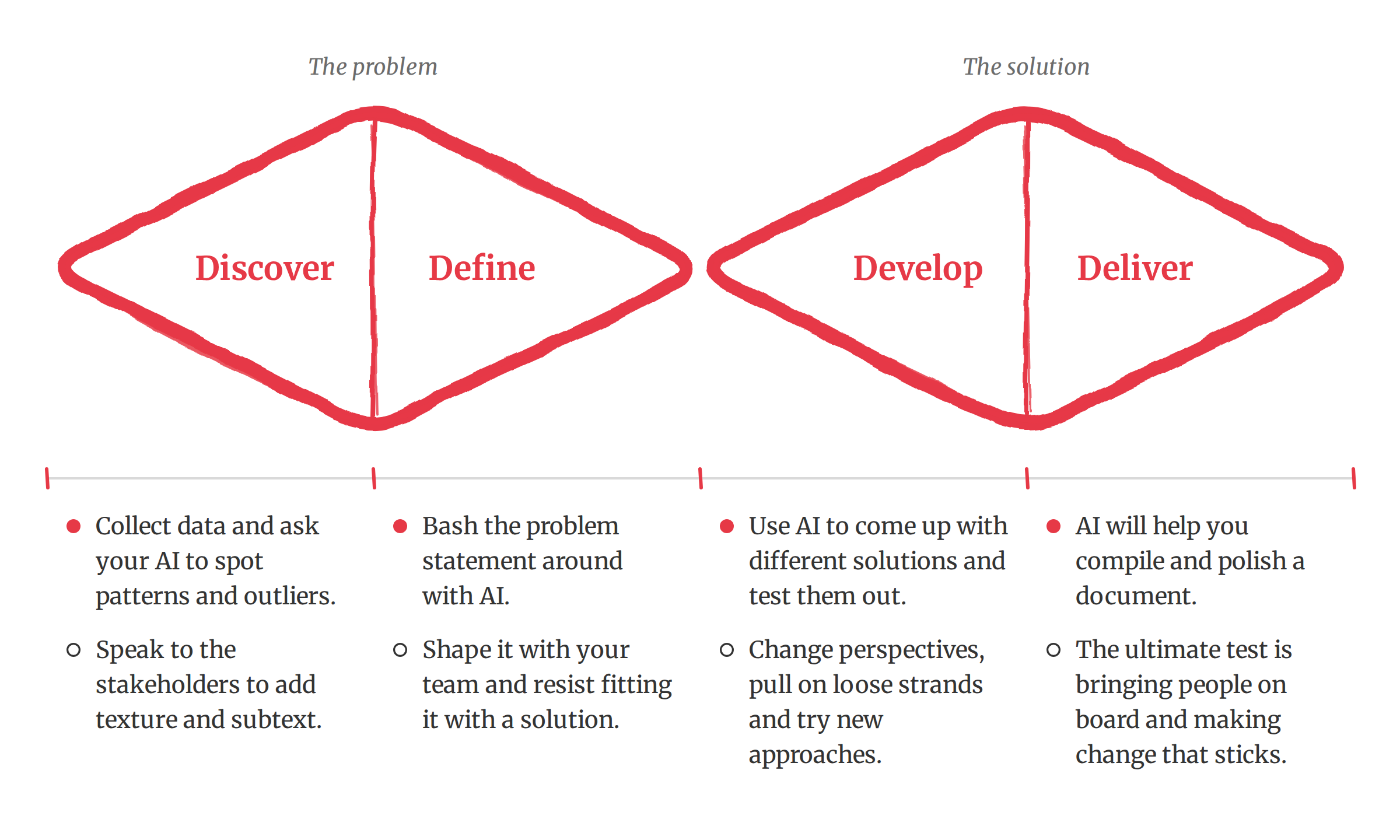
It is tempting to delegate business problems to AI, but it does not usually work. Strategy requires taking on ”wicked problems”, so-called because they have contradictory inputs and changing requirements. Design Thinking provides a great tool to tackle these problems in a structured way: the venerable Double Diamond framework.
Discover
Start by collecting data and asking your AI to spot patterns and outliers. Speak to the stakeholders to add texture and subtext, and review the findings. If the solutions offered by your colleagues or AI ring true, you had a transparency problem, not a strategy one.
Define
Uri Levine advised to “fall in love with the problem, not the solution”. Shape your discoveries into a problem statement and bash it around with AI and your team. Resist fitting the problem statement to a solution, or you will make a rushed decision.
Develop
Use notes, AI or conversations to come up with different solutions and test them out. This is the time to change perspectives, pull on loose strands and try new approaches. At this stage, a winner will likely emerge, but it still needs validation.
Deliver
Execution is everything. Ideas that are not compiled into presentations, strategies that have not been presented, have no substance. AI will help you compile and polish a document, but the ultimate test is bringing people onboard and making change that sticks.
The curious case of lost proposals
Dealing with the problem of lost proposals, I was tempted to short-circuit my own process and delegate the decision to AI. Immediately after the Discovery, the AI offered the Delivery: “Do you want a one-pager for your management team?”
Consciously, I took time to Define the problem. “Where did we go wrong?” is addressing the symptoms. I needed to find the root: do we need to tinker with the process, or does it call for a more strategic repositioning?
I filtered my Discovery findings through the problem statement, explored a few more leftfield ideas and play-acted a few scenarios with AI. My final recommendations were presented to the team for validation and implementation.
It took a while longer, but it was worth it. The initial solutions offered by AI were both too timid (tinkering with the proposal) and too disruptive (radical overhaul of the pricing strategy).
Had I accepted that solution, results would have been ineffective, and the team would have rightly pushed back. Worse, had I not gone through the process, I would not have known how to improve it as new feedback came in.
The cost of questions never asked
AI is good at solutions and bad at decisions. It operates in incomplete context, misses the interesting questions and can blunt your critical thinking. Our lost proposals were a “wicked” problem: neither data nor gut alone could make sense of it.
Picasso said that computers are useless because “they can only give you answers”. Perhaps more accurately, they give you answers too quickly. The AI offered a solution to my lost proposals problem within minutes. It was plausible, but way off the mark.
Business rewards efficiency, and AI would have saved me time getting to an answer. But the cost of all those missed questions would have been much higher.
Reading list
A severe misalignment of AI in mathematics (Math and AI) – The Fields Medallists’ case that solving problems is a proxy for understanding
The Double Diamond (Design Council) – Where the four stages came from and why they were codified.
Sycophantic AI decreases prosocial intentions and promotes dependence (Science) – Leading models side with the user far more often than people do, and users prefer it.
The impact of generative AI on critical thinking (CHI 2025) – Knowledge workers who trust AI more report thinking less critically when they use it.
International AI Safety Report 2026 (arXiv) – Its section on decision-making competence sets out what is known, and not yet known, about deskilling.