


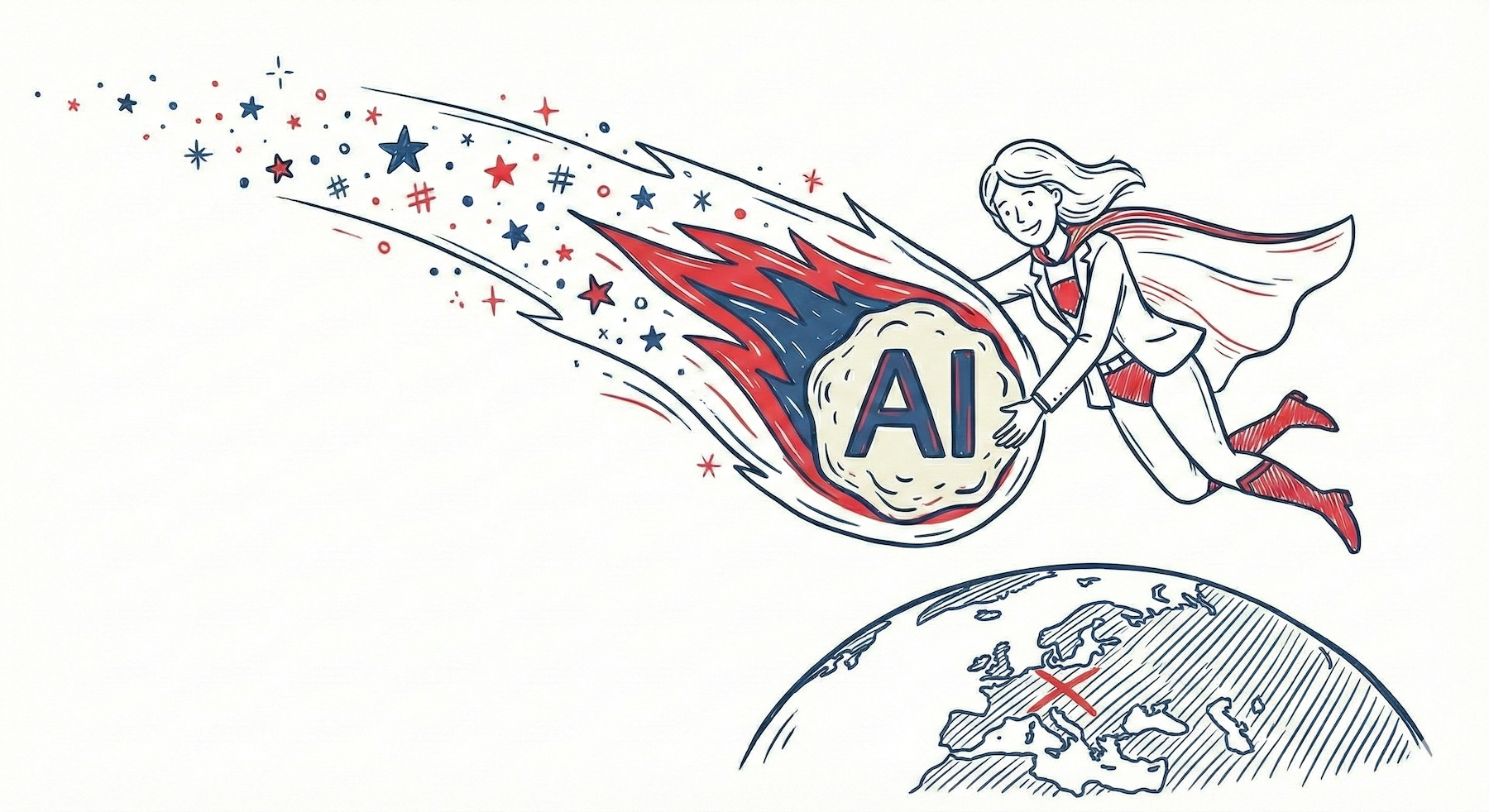
In conversations with clients and partners, AI is often depicted as a comet hurtling towards Earth. Faced with a supermassive monolith, our only choice is to brace for impact. In this narrative, the negative effects are as unavoidable as the opportunities.
This is too fatalistic. While the eventual transformation of workflows and value chains is inevitable, business leaders have discretion over the manner and velocity of adoption. Companies can, and should, exercise control over how they deploy AI solutions.
Decision 1: Augment or cut jobs?
To follow the narrative that AI creates efficiencies by reducing headcount is to prioritise short-term gains over long-term competitive advantage.
Deploying AI to retain staff is a strategic choice. By automating mundane tasks and empowering your team to focus on high-value work, workers become more essential to the business, not less. Happier teams are more productive, leading to higher customer satisfaction and loyalty.
Decision 2: Momentum versus safety
The “move fast and break things” mantra of Silicon Valley is often ill-suited to mature companies, where reputations are hard-won and easily lost.
Balancing momentum with rigorous testing for safety, privacy and accessibility is prudent. Agility is important, but when the technology has the potential to mislead or leak personal data, not every iteration is fit for the public domain.
Decision 3: Environmental impact
Just because AI providers subsidise their services to claim market share does not mean environmental costs are gone.
There are practical ways to minimise the carbon footprint of AI solutions. This involves using LLMs only when necessary and opting for smaller, more efficient models where possible. Training teams to economise on energy-hungry prompts (particularly in video generation) and carefully selecting vendors are solid steps toward sustainable AI.
Decision 4: Limits to autonomy
Technological capabilities are always moderated for safety. Just as driving speed is limited well below the car’s capability, leaders must be careful to place limits on AI autonomy.
Allowing AI to handle specific, low-risk tasks is acceptable, provided a human remains in the loop to approve all non-reversible operations and final outputs. As regulation struggles to keep pace with technology, leaders bear a greater responsibility to enforce appropriate safety measures.
Decision 5: Vendor selection and US monopoly
The assumption that American tech giants are the only vendors of AI models and services should be challenged. For Europeans, total reliance on US companies risks losing jurisdiction and sovereignty.
Europe possesses a flourishing ecosystem of AI companies, particularly at the application layer. Supporting local vendors encourages entrepreneurship, innovation and helps develop the technology ecosystem. In an era of geopolitical uncertainty, vendor choice is a core component of risk management.
Mind your business
Struggling with basic AI adoption, some companies may find the burden of ethical decision-making too heavy. Others will disagree with these concerns or not deem them urgent enough.
The key takeaway is that AI is not a one-size-fits-all proposition, and that business leaders have the power of choice. Given its transformative power, how they exercise that power is a profound expression of their companies’ values and future direction.