

“Mr President, it’s going to seem to some people like you did it ‘cause your daughter asked you to.”
“Josh, if you ever have a daughter, you’re going to discover there are worse reasons in the world to do something.”
Like many Centrist Dads, I look at The West Wing for closing arguments to my internal dialogue. Pondering my daughter’s vocal opposition to AI, I was reminded of the episode where President Bartlet was nudged by his daughter to make a politically awkward decision.
She is not the only member of Gen Z to feel that way. As David Mattin writes, the backlash against AI is not only gathering pace, but marks an “inversion of the generational dynamic we usually see around new technology”. Young people refuse to accept that AI is the future and are actively hostile to it.
We should listen. As a technologist, I see that sentiment is rapidly shifting from scepticism to outright hostility. It is time to act.
It is time we press pause on AI
The AI backlash is real, generational and building fast. Three regulatory models — medicine, data privacy and gene editing — show how development can be slowed without being stopped. Business leaders who act before the rules are in place will be better placed than those who wait to be told.
Winners and losers
As the fastest-adopted tech in history, AI sparks heated debate. Neil Postman wrote that all technologies are contested as they create winners and losers: the insiders reap the benefits and outsiders bear the costs. The temperature of the debate is determined by how widely and quickly the tech is adopted — and AI tops both measures.
The insiders get a really sweet deal. High-performing portfolios, efficient businesses, fat consulting fees. Automating the legwork makes coders, lawyers and managers more effective. With calls transcribed, action points recorded and documents created, we really do get time for “higher value” work.
All this comes at a high cost. AI is eating up vast amounts of energy and resources. It regurgitates human creativity, flooding the internet with slop. AI can empower those seeking to stage cyber or biological attacks — or do the job itself. It is already affecting graduates’ employment prospects.
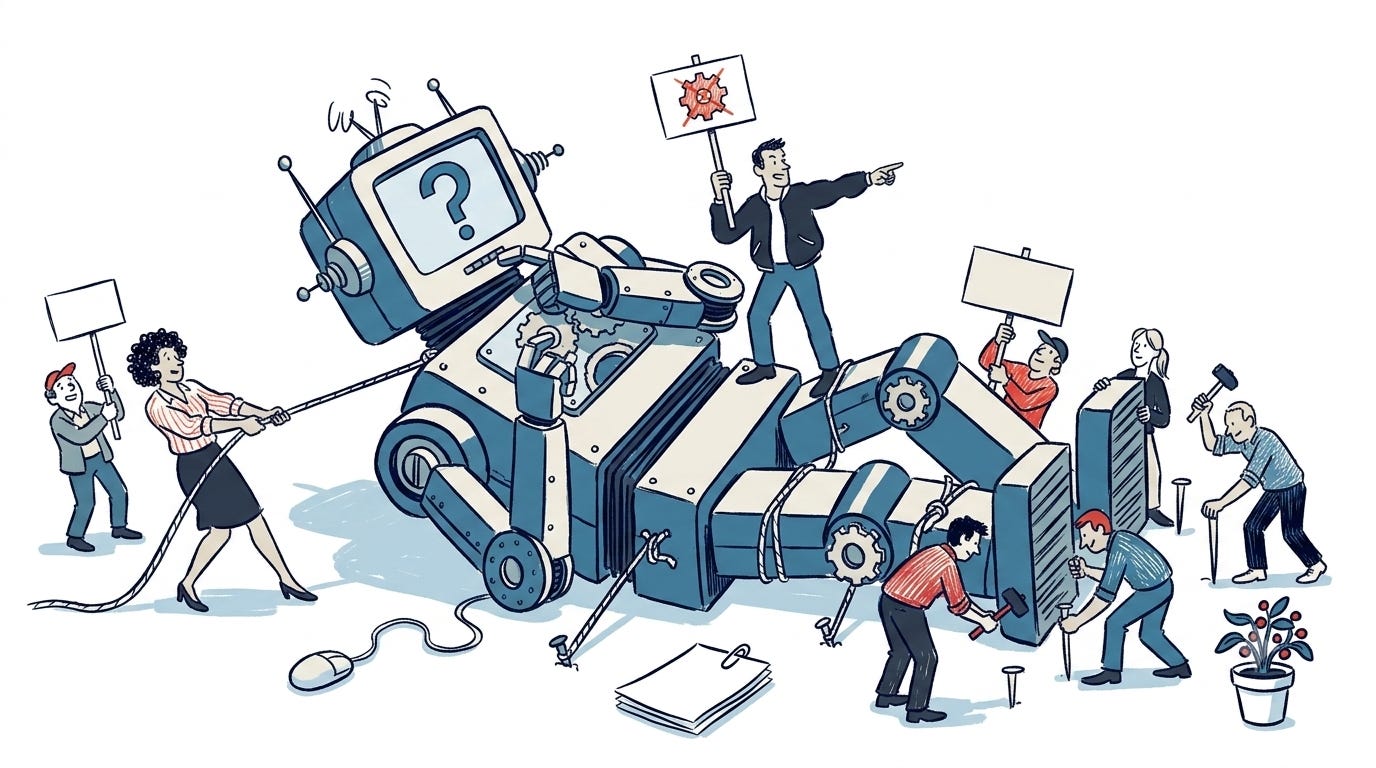
We urgently need regulators to step in, but governments and transnational organisations are slow to act. No amount of money can expedite deliberation, leadership and consensus. It is time to pause AI development and wait for the messy, human stuff to catch up.
A moratorium on frontier AI
We need a moratorium on frontier AI development, whilst we work out an international consensus on safety. Some of the activist proposals sound sensible and not too far from what Anthropic attempted by restricting potentially dangerous models from public use. Unusually, Dario Amodei, the Pope, Bernie Sanders and Steve Bannon concur.
We need a moratorium on frontier AI development, whilst we work out an international consensus on safety.
Pausing AI will allow us to take a step back, consider carefully and implement regulations that balance risk mitigation and friction. For inspiration, we can look at how we control medicine, privacy and gene editing.
Restrict access — like medicine
We can all buy paracetamol, but certain medicines require a prescription. We can apply a bandage, but only trained professionals can perform surgery. Similarly, we should all be able to use the models available today, but the most powerful ones should be subject to controls. Potentially dangerous ones, like Mythos, should be permanently locked to professionals. Coming up with universal classifications would take time, but would help mitigate the most serious risks.
Enforce opt-outs — like privacy
Cookie popups are annoying, until you consider the alternative: what if every website you visited got to collect your name and other personal details? We should require explicit consent before someone’s words or voice are used to train a model — and before they are served AI-generated content. GDPR is a pain, but it places the burden of responsibility on those who benefit from processing personal data.
Control rollout — like gene editing
Following a 2018 scandal, the scientific community and regulators imposed a moratorium on the riskiest uses of CRISPR. Research continued under controlled conditions or paused pending consensus. Governments can slow the AI rollout by regulating demand through taxes and making it cheaper for companies to hire junior staff before expanding their AI operations.
Good news for business
When the regulations arrive (and they will), the businesses that moved first will find it easier to adapt.
Customers and employees are watching, and businesses that earn a reputation for restraint will gain more than “efficiencies”.
Trust is hard to gain and easy to lose. Customers and employees are watching, and businesses that earn a reputation for restraint — deploying the most powerful models only where the case is genuinely clear, asking before putting AI in front of customers, keeping junior staff in the loop rather than cutting them out — will gain more than “efficiencies”.
None of this requires waiting for governments to act. Consent, transparency and proportionality are not regulatory burdens. They are the minimum conditions for using a contested technology thoughtfully and respectfully.
Should we pause AI because our kids ask us to? As Prez Bartlet would say, there are worse reasons in the world to do it.
Further reading
Just Get on the Rocketship — David Mattin, New Worlds Same Humans. The generational inversion argument: why younger people are rejecting AI.
Neil Postman’s Technopoly — Julian Girdham. A readable introduction to Postman’s framework for understanding how technologies create insiders and outsiders.
Our Proposal — PauseAI. The activist case for a moratorium on frontier AI development. More measured than the name suggests.
Is AI putting graduates out of work already? — The Economist. Early labour market data suggest the employment effects are arriving faster than expected.
AI Diffusion Report: Mapping Global AI Adoption and Innovation — Microsoft. The adoption velocity data makes the regulatory lag so striking.