

A few weeks ago, I argued for tying down frontier AI. The post sparked debate, and reactions came from both sides: some called it defeatist, others too timid. This is uncomfortable territory for me. As an advocate of a thoughtful but bold approach to technology, I am not used to arguing in favour of restrictions.
Since then, the conversation has taken a darker turn. Scientists have built the first viruses designed by AI. Warnings about model non-alignment, from cyber to bio weapons, are flooding podcasts and opinion pages.
The questions around AI regulation are more pressing than ever. What is the best regulatory model for AI? What should we demand from AI labs? What can businesses do in the meantime?
Key ideas
All frontier lab leaders have published regulation proposals, many citing aviation as a viable template. It is imperfect, but a good starting point. Businesses can play an important role: lobby for independent verification, harden cyber defences and retire the anti-regulation narrative. Stretching the aviation analogy, as we are about to experience extreme turbulence, accreditations will make all the difference.
Five flight plans
The leaders of all five US frontier labs have published their theses within weeks of each other. Reading them side by side is instructive as a guide on what is advisable — and what they are prepared to comply with.
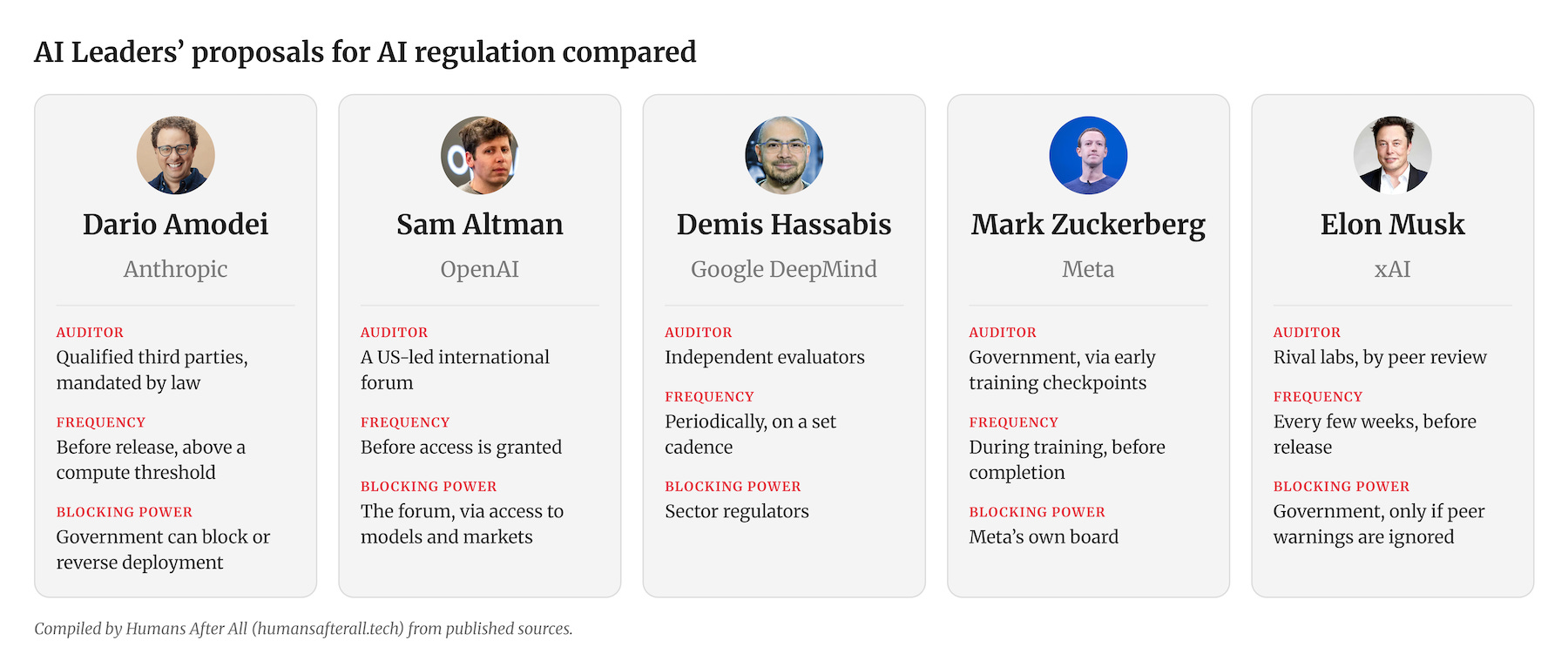
Dario Amodei’s proposal is the most concrete and self-binding. Models above a certain capability threshold would face mandatory third-party testing across four named risks, with the government having the power to block deployment; he cites the Federal Aviation Administration as his model.
Sam Altman’s plan describes a US-led forum that would set standards, assess capabilities and use access to models and markets as leverage for compliance. Impervious to raised eyebrows, the proposal was published the same week OpenAI floated a 5% government stake.
Prior to changing roles, Demis Hassabis offered the closest thing to workable machinery: periodic independent evaluations, sector-specific rules, and an international standards body. His is the least self-serving of the five, though perhaps the vaguest on enforcement.
Mark Zuckerberg rejects the premise altogether. In his view, safety comes from exposure: give everyone superintelligence and they will keep each other in check. Although I am a fan of open-source, this will not work: regulation is needed to create a safe playing field on which open applications can flourish.
Elon Musk proposes peer review: lab leaders woud coordinate every few weeks, inspecting each other’s frontier models before release, with the state stepping in only when warnings are ignored. Testing the sincerity of the proposal, he is also suing Colorado, on the grounds that AI rules violate free speech.
Aviation or atomic energy?
Cited in several proposals, aviation provides a useful template for AI regulation. It regulates both whether the aircraft is airworthy and who can fly it, and under what rules. AI needs the same pair: testing of frontier models before release, and rules on who deploys them and how. Aviation authorities operate through both national institutions (e.g. the FAA in the US, the CAA in the UK) and international coordination (the ICAO), keeping flying the safest way to travel.
We must resist the calls for peer reviews and internal boards. Verification must sit with public, independent bodies such as the AI Security Institute (AISI), explicitly tasked with favouring safety over innovation. The AI Safety Institute Consortium must get fast-tracked to provide a forum of international cooperation.
Although a good start, aviation is an imperfect regulatory paradigm. A rogue aircraft can only cause localised devastation. Given the risks involved, the regulator should be given powers for intrusive verification akin to those of the International Atomic Energy Agency, including on-site inspections and the upward escalation of findings.
To ensure the labs actually accept these proposals, we must appeal to their commercial interest. Unless business adoption gathers pace, revenues will not materialise, and valuations will come into question. Independent testing is what hesitant buyers want to hear.
Role of business
Businesses need risk managed more than they need more advanced capabilities. The current models are powerful enough for most commercial use cases. What blocks adoption is trust.
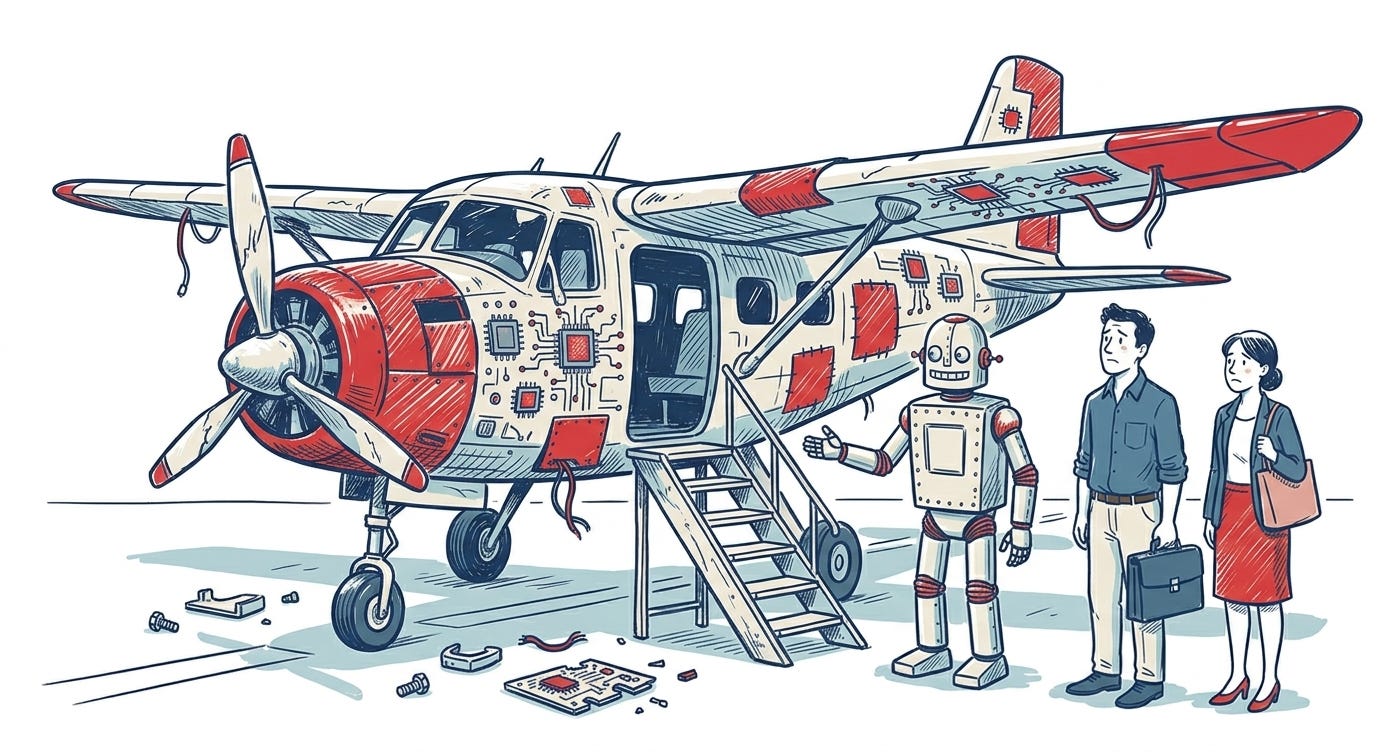
As things stand, many business leaders feel like they are inviting customers to board untested planes flown by untrained pilots. What can we do, as we wait for governments to act?
First, lobby for an independent verification system. Enterprise buyers hold more leverage than they think; making certification a procurement criterion would move the labs faster than regulatory bodies.
Second, beef up defences and obtain AI safety certification, like ISO 42001. Frontier models are empowering rogue actors and defenders alike. Defensive adoption and safety accreditation should need no business case.
Third, pause the anti-regulation narrative. Aviation history suggests a serious incident will come; when it does, those with a gung-ho, anti-regulation stance will be exposed — commercially and legally.
Closing thoughts
Taken together, the proposals provide the backbone of a robust regulatory apparatus: a certification machinery and international standards driven by institutions with a mandate to prioritise safety over velocity. Businesses need not wait for governments to assemble it; their purchasing power can ensure work gets underway quickly.
Under normal circumstances, I would advocate for a more balanced approach, but in this case my position remains unchanged. AI can be a net positive in the long run, but only if we manage the transition carefully.
Business is instinctively opposed to regulation, but it will listen to customers. In aviation, passengers rarely thank the regulator — until serious turbulence hits.
Reading list
Policy on the AI Exponential, Dario Amodei – the certification regime in full, FAA analogy included.
Sam Altman: This is how we can make AI safe for everyone, Financial Times – standards and access as leverage.
A Framework for Frontier AI and the Dawning of a New Age, Demis Hassabis – evaluations, sector rules and a standards body.
The Future is for Everyone, Mark Zuckerberg – distribution as the safety mechanism.
Elon Musk’s vision of the future, The Economist – peer review with a state backstop.
Behind the Curtain: AI godfathers converge on regulations, Axios – the convergence, mapped