


One of my first “wow” moments with the internet was playing backgammon with a friend on a VAX terminal. Sure, it was just crude green characters scrolling on a black screen, but it was still magical. Not just because he was in Greece and I was in the UK, but because we were not just exchanging texts; we were interacting in real time.
As 2025 comes to a close, we are approaching a similar point with AI. The generative capabilities are great, but a static context (a prompt) can only take you so far. The real “wow” factor is when the AI can react to the prompt dynamically, autonomously consulting multiple data sources to deliver the best possible answer. This, in a nutshell, is agentic AI - and it’s coming closer.
Read on to learn
How agents benefit SMEs and empower their human workforce
Why open standards mean the time is right for wider adoption
Use case: how agents automate a custom pricing workflow
Why Agentic is good design, but also good architecture
I. Agents, for humans
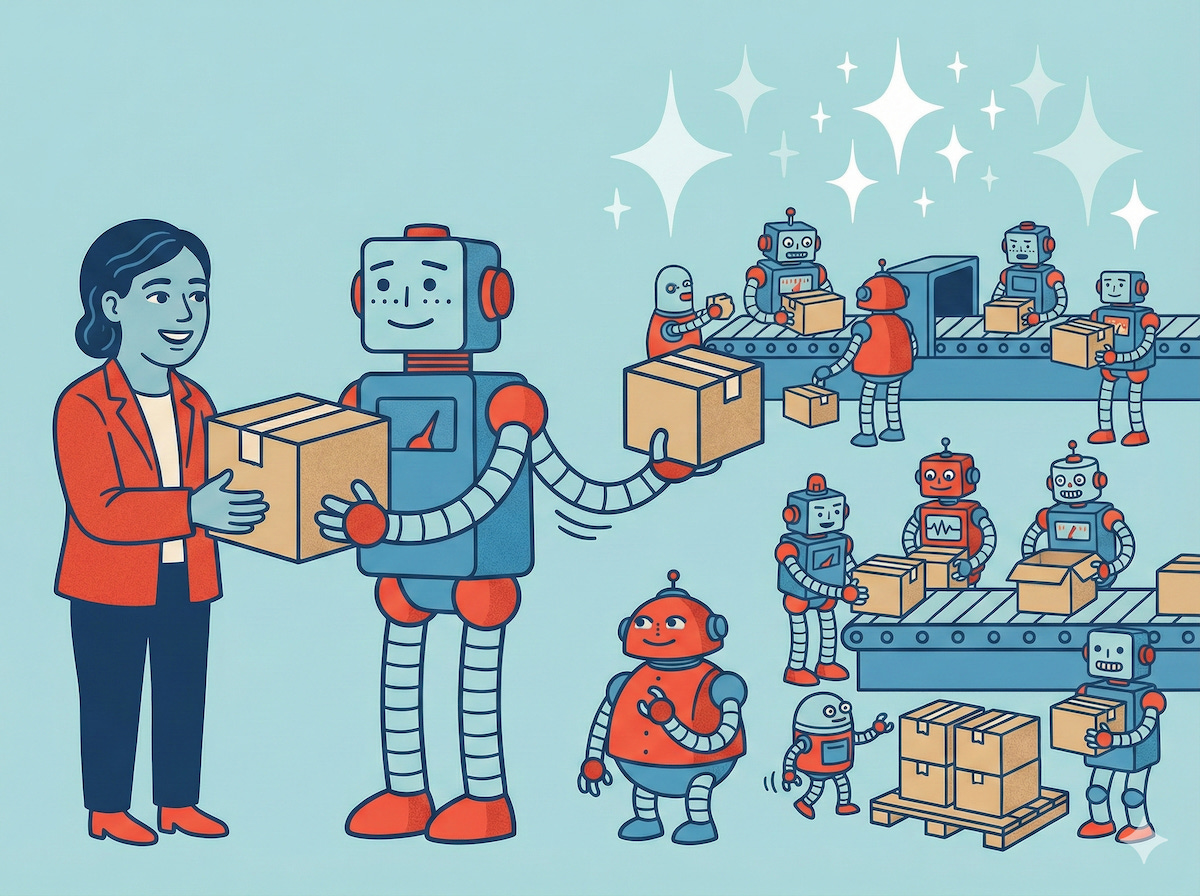
Agentic AI is an entirely new human-machine interaction model because agents are authorised to act. Instead of asking a chatbot how to book a meeting, you tell the agent to go ahead and book it. With proper orchestration, the agent will know to check the calendar, send invitations and update the CRM.
Automating such tasks can be tremendously beneficial for SMEs that need to generate results with smaller teams. By providing a digital workforce to handle repetitive tasks, your team can focus on higher-value work. For advocates of human-centric AI adoption, agentic architectures bring it all together: freed from clerical work, teams are empowered to operate at a higher level.
II. Open standards matter
The key obstacle to adopting cross-system agents is interoperability. Unless all agents speak a “common language”, companies will have to allocate budget for every additional connection, causing costs to skyrocket.
This all changed in December with the launch of the Agentic AI Foundation. Organised by the Linux Foundation, the initiative brings together tech giants to agree on that common language. Whilst there is competition with Google’s A2A, the cooperative streak that runs through the industry should ensure a mutually beneficial convergence.
“Agentic standards lower development costs, making agents accessible, interoperable and future-proof”

Much like W3C web standards, the emergence of agentic standards will make adoption cheap and accessible. Companies do not need to build proprietary connections, lowering development costs and making their agents interoperable and future-proof.
III. Custom pricing with AI agents
To illustrate how Agents can help, consider the frequent scenario of individualised pricing. The Account rep is creating a proposal and wants to know if the customer is eligible for any discounts or other pricing incentives. The underlying data is stored in 3 systems from different vendors.
In a traditional CRM, the rep would need to retrieve the data and then manually create the report. GenAI can accelerate report production, but the rep would still need to compile the data because the LLM has no access to it. In an agentic setup, the agent takes on the data research tasks and goes all the way to create the report that the rep actually needs.
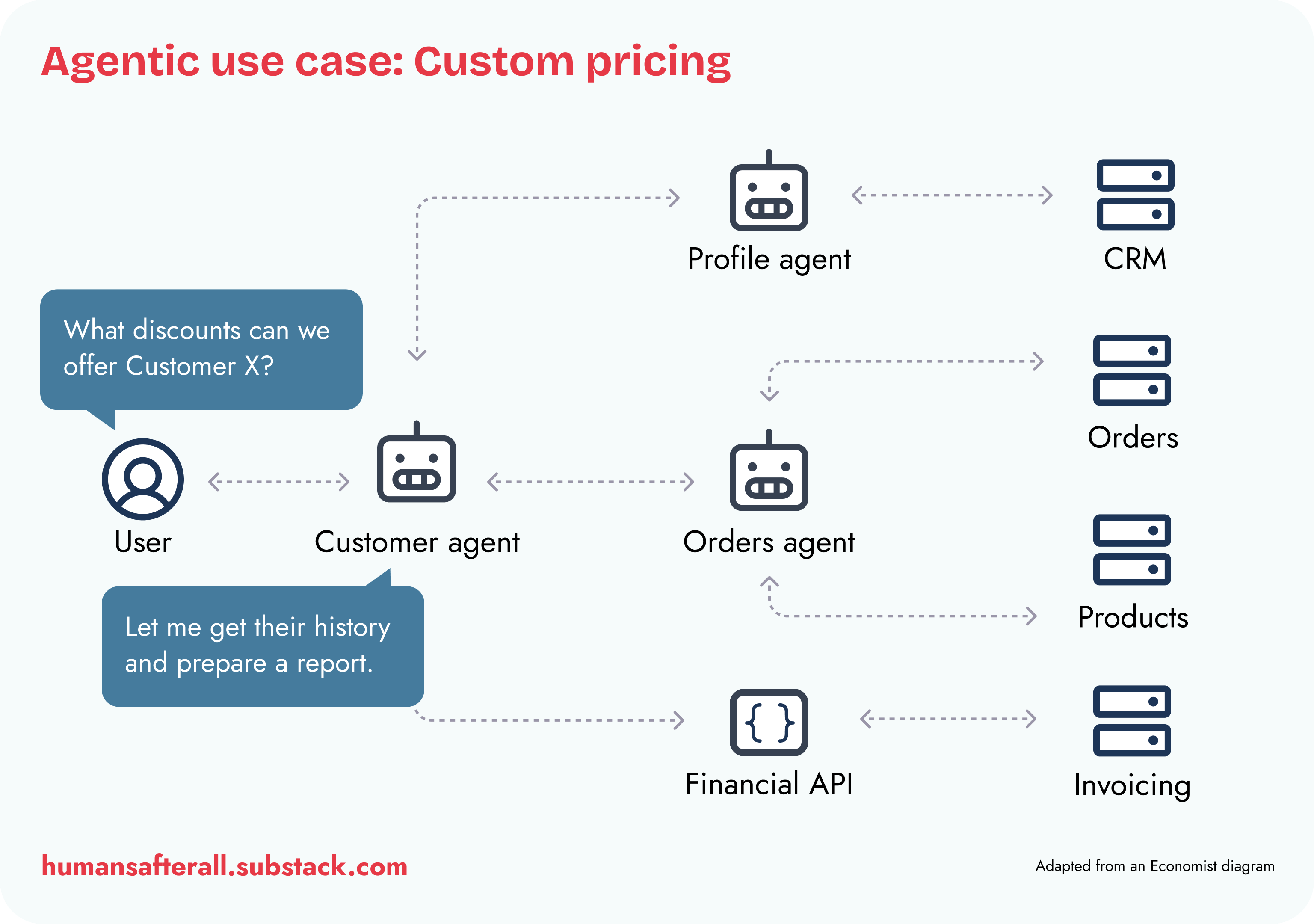
The agent is a clever little helper. It parses the prompt and knows it first needs to ping the Profile Agent to collect the customer’s information. It will use that data to request the Orders Agent to list their purchase history in the Orders and Product systems. Finally, it will query the Financial API to check the Invoicing system for late payments.
In the final steps, the agent uses its language capabilities to compile a report and interface with the user in plain Language. It’s all super helpful, user-friendly and obvious, right? It gets better.
IV. Enabling good architecture
Delegating data administration to agents is sound systems architecture beyond workflow improvements. Like all data integrations, agentic exchanges are fast, secure and scalable. However, unlike their traditional cousins, their language-based foundations make them very flexible.
For one thing, they understand the domain and allocate numbers appropriately, raising alerts when the data looks wrong. For example, a €1M transaction is normal in banking, but not in retail. They can also work sequentially, making calls to agents after the necessary information has been collected.
“Language-based foundations make agents very flexible. You can extend the life of older tools by integrating them into an intelligent workflow”
Finally, they can use legacy connection methods (APIs, database queries, file repositories) to help companies manage legacy systems and get a complete picture of the business. In many cases, you can extend the life of older tools by integrating them into an intelligent workflow.
V. Making it all click
The wow factor of online backgammon on those ancient VAX terminals was that my friend Nick and I were not just communicating; we were doing something together. Similarly, agents go beyond chatting and proactively collaborate with other agents to achieve the desired outcome. Build a digital workforce to help the human variety dedicate more time to higher-level tasks: thinking, creating and connecting.
As Dieter Rams said, “the best Design is as little Design as possible”. Autonomous data integrations may not sound very exciting, but when everything clicks, it is as good as Design gets.