

Two conversations last week captured the current mood perfectly. One is about deciding where to start, the other is about whether it is over.
A final-year student asked me whether she should bother specialising in financial analysis, given what AI can already do with a spreadsheet. A developer with twenty-five years of experience told me quietly that his company is looking at AI to “rationalise” its senior-level headcount.
These conversations matter because unaddressed anxiety has consequences. Every redundancy, every hiring freeze, every restructuring will be attributed to AI, fairly or not. While it is true that evidence of AI-linked job displacement is insufficient, we must act before the data confirms the problem.
Should we protect jobs from AI displacement, or let the market dictate the pace? What will the transition look like? What is the role of the state, businesses and individuals? A serious conversation about what we owe each other during this transition is urgent.
Protecting jobs during the transition
By the time the data confirms AI’s impact on jobs, it will be too late: we need to start now. Governments must update safety nets and invest in young people. Companies and individuals should realign their expectations of each other. We must all act early and in unison.
The messy middle
To get a good sense of the debate, head out to the Platformer. Boris Cherny, who built Claude Code, hasn’t written code himself in six months and thinks the title “software engineer” could begin to disappear by year’s end. The effect, however, might be limited to coding. Box CEO Aaron Levie argued that the “last mile” of human judgement resists automation, while Google’s James Manyika noted that whole-job automation remains below 10% of occupations.
A more useful framing comes from Brookings researcher Molly Kinder, who focuses on the transition — what she calls the “messy middle.” Not a jobs apocalypse, not business as usual, but a prolonged period in which AI reshapes knowledge work without triggering the visible disruption that commands a policy response.
It is an uncomfortable place. Roles get hollowed out before they disappear. Entry-level hiring slows before it collapses. The workers most exposed are the “laptop class”, the people who did well during the pandemic precisely because their work required a computer and a brain.
The China Shock is the cautionary tale. Millions of manufacturing jobs disappeared, and while the economy recovered, many communities did not.
The China shock — a symbol of the negative effects of globalisation — is the cautionary tale. Millions of manufacturing jobs disappeared, and while the economy recovered, many communities that relied on them did not. The political bill arrived two decades later in the form of populism and zero-sum politics.
AI job displacement will be faster and sharper. By the time we have enough data to rationalise the anxiety, it will be too late. We must make plans for the messy middle now.
The role of the state
In Europe, the expectation that governments provide a safety net for all citizens is not ideologically contested. The state should intervene where markets will not self-correct, and labour transitions at this speed qualify.
Universal incomes and capital accounts are interesting ideas, but no silver bullets. Targeted interventions will work better: wage insurance for older displaced workers, generous unemployment support that promotes action, and retraining that builds competencies rather than shallow AI literacy.
As populations age, what can be more important than investing in youth, our most precious and scarce resource?
Above all, states must incentivise junior hires. Given the long-term effects of youth unemployment on an economy, subsidising early-career positions is not welfare, but an investment. As populations age, what can be more important than investing in youth, our most precious and scarce resource?
What companies owe their people
Business leaders are not passive here. As I argued previously, deploying AI to augment rather than cut is a strategic choice. Companies that make it a deliberate priority will outperform those that treat headcount reduction as the default dividend of productivity gains.
The commercial case is straightforward: firms that cut first and explain later will struggle to recruit the talent that AI actually requires. Pursue growth as the first response to efficiency gains. Hire juniors even amid uncertainty: as AI is compressing career progression, juniors will be great return on your investment.
Communicate honestly about what is changing. A firm that gives its people time to adapt is making a statement about its values. One that does not should expect neither loyalty from its talent nor sympathy from its government.
We must all adapt
At the individual level, professionals in all career stages must be open to change by expanding their “human last mile”. Exercising judgement, reading the room, building trust and setting priorities is work that AI will never replicate at scale.
Supervising AI output can be tedious, but also liberating. Delegate routine tasks to the machine and can spend more time on questions, communication and reimagining the flow of work. The people adding the most value right now are positioning themselves as agents of change within their organisations.
The era of working in narrow lanes is ending: as AI takes on routine tasks, humans are expanding into adjacent areas.
That requires breadth. A recent study shows how AI blurs the roles, encouraging business colleagues to code up prototypes and tech people to offer commercial solutions. The era of working in narrow lanes is ending: as AI takes on routine tasks, humans are expanding into adjacent areas.
Treat your career as a portfolio rather than a ladder. Stay alert and keep an open mind to change — including change that might feel like a step sideways.
Acting in unison
We do not get to choose the times we live in: it will get harder before it gets better. We must have the job conversations now, while the data is still ambiguous, rather than later when the damage is done. “Great job creation figures” are not an answer to a student deciding what to study or a developer wondering whether to retrain.
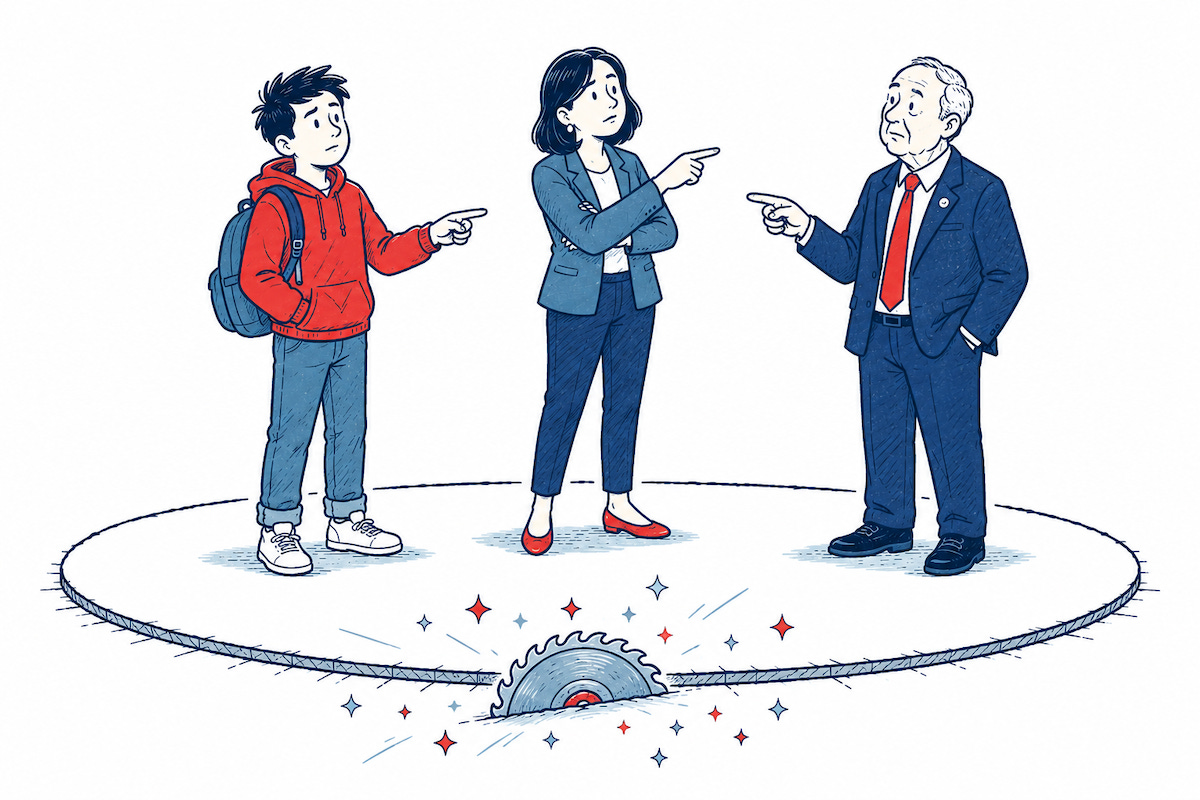
Right now, everyone is waiting for everyone else. Companies are waiting for regulation. Governments are waiting for data. Individuals are waiting for someone to tell them it will be fine. AI is advancing so quickly that we must all act early and in unison.
It is not wrong to crave certainty before we make changes. But the pace of change requires us to act regardless.
Reading list
The messy middle — Platformer. Molly Kinder on the uncomfortable space between now and the promised gains.
The end of the software engineer — Platformer. Boris Cherny on why coding is already solved, for some definitions of solved
The Cybernetic Teammate — Harvard Business School. A study that shows how AI helps humans broaden skills
How to Share AI riches — Economist. Sharing AI capital gains is an interesting idea, but not the solution to its problems.
The power of choice — Humans After All. Business leaders can control both the direction and pace of deployment