


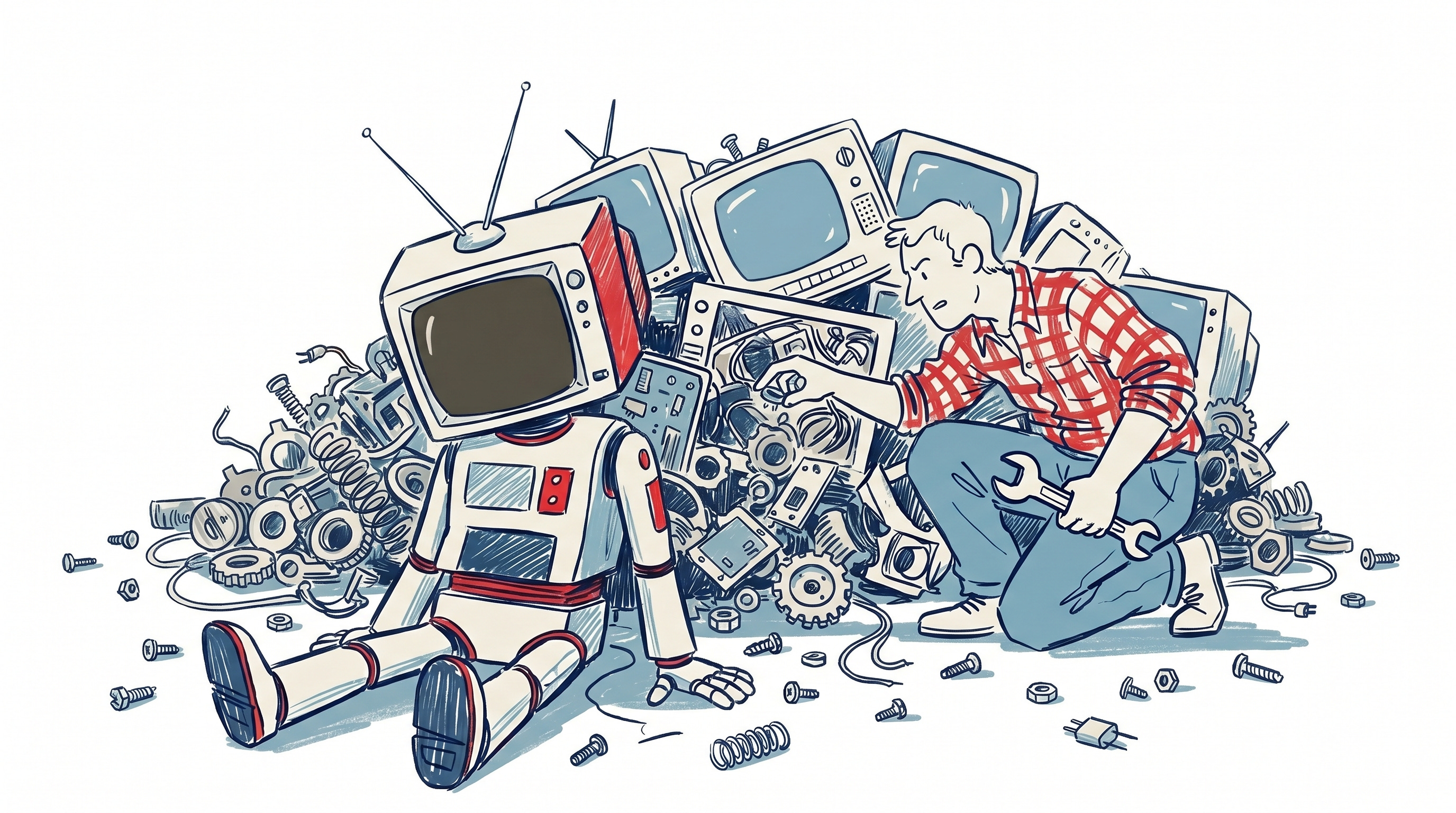
“Can we have AI without the drama?” is the adoption brief I get most. Will we have to sit through 15 meetings with HR, IT or Compliance to make it happen? Why won’t the media stop going on about it? Can we dial down the weirdness a bit?
My clients are right to be wary. Their concern stems from pieces like Ethan Mollick’s recent article, which argues that businesses are squandering AI’s potential by treating it like any other technology. In his view, AI is a “mysterious alien artefact… used as a paperweight”. Companies need to “embrace the weirdness” and create Labs tasked with “pushing boundaries and feeding discoveries back into the organisation”.
In other words, “more drama, please”.
Back in the real world, this is not how transformation happens. Instead of bold vision statements and endless experimentation, leaders need to dial down the drama, and (a) balance caution and ambition, (b) align with overall strategy, and (c) measure the right things.
AI transformation will be messy and gradual, and will not make for good television. And contrary to Mollick’s advice, the IT department will play a leading role.
I. Balance safety and momentum
When an argument is followed with a note that it is “not a criticism”, chances are that it is exactly that. Mollick certainly sounds critical of IT departments, which he reckons are too focused on managing risk so they can “sleep better at night”.
No criticism, but deploying AI without IT on board is nonsense.
True, IT departments are not generally designed to be engines of innovation. Their primary role is to ensure safety and continuity, and to provide a level of organisational discipline. IT will manage your AI like the rest of your stack, and it is naive to think you can transform without them.
Flipping the argument, the onus is on AI labs to make their product IT-friendly. No amount of highfalutin rhetoric about transformational potential can hide from the fact that most AI software is immature and unreliable. Given its potential impact on cybersecurity, vendors could do well to focus on safety over velocity.
II. Change for the right reasons
When did we collectively decide that AI must be the driving force for all business change?
Most businesses change because of shifting market forces, only one of which is technology. In most cases, change is driven by regulation, supply chains or customer demand. True, a generalist technology will redraw the competitive landscape, but companies will react to the new opportunities and threats.
Companies do not need “technical and non-technical employees (that) work on generative AI full-time”. If they do a bad job of keeping an eye on competition, customers and regulation, no Lab will keep them in business.
Thinking that Labs will drive transformation is typical of academia and Silicon Valley dreamland. Deciding where to swap low-risk profits today for high-risk profits tomorrow is probably the hardest thing in business. Leaders seek convergence and focus, not experiments and multi-disciplinary teams.
III. What success looks like
Another curious notion is that attaching a KPI to AI transformation would somehow prevent companies from realising its potential.
It is unrealistic to expect businesses to give AI a blank cheque. Leaders need to set objective targets to measure outcomes and plan next steps. As AI evolves so quickly, adoption requires multiple rounds of trial and error. Without clear targets, it would be impossible to separate what is working and what must be improved.
Managers will not cut jobs just because they read “studies showing 30% productivity gains”. They will, however, expect improvements in effectiveness, quality and customer satisfaction, all of which can be measured and improved.
Nothing communicates leadership’s vision more clearly than the choice of KPIs. The right targets — higher revenue per employee, faster workflow throughput, stronger customer loyalty — will reassure teams and accelerate adoption.
IV. Takeaways
In my view, Mollick makes a broadly correct diagnosis, but his prescription misses the mark. Business leaders may drive AI adoption faster by considering the following:
1. Get a temp Chief AI Officer
Mollick may be wrong to discount IT’s role, but he is right in that IT cannot drive adoption. Like a Chief Digital Officer in the 2010s, many companies will need a central coordinator to encourage experimentation and ensure alignment during rollout. Labs are vague and expensive, but a temporary Chief AI Officer communicates focus and innovative intent.
2. Watch the market, not the model
Businesses will have to transform because AI will impact regulation, cost structures and customer expectations. There is no point in trying to second-guess the technology. At times of upheaval, maintain a candid and up-to-date SWOT matrix. As you watch competitors jump headfirst, remember that early adoption is a treacherous path to competitive advantage.
3. Measure the right things
Leaders communicate intent through metrics, but those metrics have to be the right ones. As an augmentation technology, AI should make your team more effective, your workflows smoother, and your customers happier. You can expect a clear uptick in KPIs such as revenue per employee, time-to-market, issue resolution speed, customer retention and net promoter score.
V. Closing thoughts
Having made massive bets on data centres, the AI industry would love to see businesses adopt it faster and more deeply. However, transformation is a high-risk game. Done badly — leaving key stakeholders out, doing it for the wrong reasons and failing to measure benefits — will lead to poor results.
Leaders will have to be deliberate, diplomatic and careful. AI transformation will not make great TV, but businesses do not want more drama.
Further reading
The Economist — The IT department: where AI goes to die (Ethan Mollick)
UK AI Safety Institute — Our evaluation of Mythos Preview capabilities
McKinsey — The state of AI in 2025: Agents, innovation, and transformation
Benedict Evans — AI eats the world (Autumn 2025)
Humans After All — Chief AI Officer: an important but temporary role